
Table of Contents
On O‘ahu, the list price is only part of the story. Monthly HOA or AOAO (Association of Apartment Owners) fees shape what you can actually afford and how long a property sits on the market. These fees cover shared maintenance, master insurance, reserves, and common-area costs. Because lenders generally account for these fees when evaluating housing expenses and debt-to-income ratios, higher fees can reduce the mortgage amount a buyer qualifies for.
For sellers, high or rising fees can shrink the buyer pool and invite price negotiations. Understanding the numbers helps both sides move with clearer expectations.
Why O‘ahu HOA and Maintenance Fees Run Higher
Building age, insurance costs, reserve needs, amenities, and the condition of shared systems can all affect association fees. Older buildings may face significant costs for repairs and deferred maintenance, while newer developments can also carry high fees because of insurance, amenities, and reserve requirements.
UHERO’s 2026 Hawaiʻi Housing Factbook reports a median monthly HOA/AOAO fee of $470 for Hawaiʻi homeowners who pay these fees, compared with $526 in Honolulu. UHERO also found that O‘ahu listings in February 2026 had a median advertised HOA/AOAO fee of $882. Many active O‘ahu listings carry substantially higher fees than the statewide homeowner median.
Fees commonly cover:
Building and common-area maintenance
Master insurance policy
Reserve contributions for future capital projects
Management, security, landscaping, and shared utilities
Special assessments for major repairs or underfunded reserves can appear on top of the regular monthly amount.
How Fees Reduce Purchasing Power
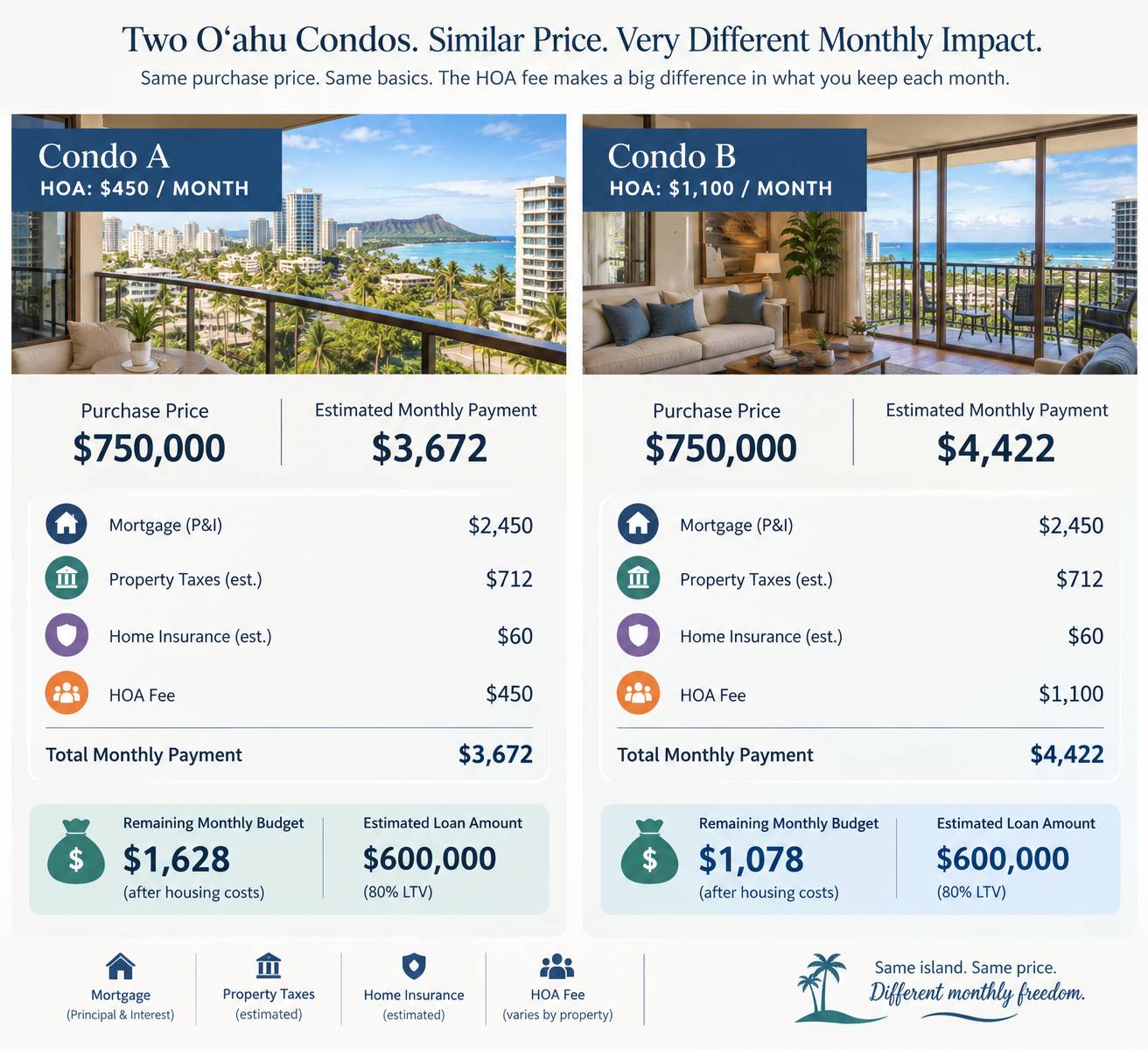
Lenders calculate housing costs as principal, interest, taxes, insurance, and HOA/AOAO fees. The higher the fee, the less room remains for the mortgage payment under standard debt-to-income guidelines.
A practical rule of thumb used by many mortgage professionals: As a rough illustration, $100 in additional monthly housing costs can reduce the mortgage amount a buyer qualifies for by roughly $15,000 to $16,000 under certain recent-rate and underwriting assumptions. The actual impact varies by lender, loan program, interest rate, taxes, insurance, and the buyer's overall debt and income.
The table below illustrates the potential impact:
Monthly HOA Fee | Approximate Reduction in Purchasing Power |
|---|---|
$300 | $45,000 – $48,000 |
$500 | $75,000 – $80,000 |
$700 | $105,000 – $112,000 |
$900 | $135,000 – $144,000 |
$1,200 | $180,000 – $192,000 |
These are estimates only. Your actual qualification depends on income, credit, other debts, and the specific loan. VA buyers also need to confirm that a condominium project meets VA requirements. Your lender can explain how the project's approval status, association finances, insurance, and other project requirements affect the loan.
A buyer targeting a total housing payment of $4,000 per month who faces an $800 HOA fee has only about $3,200 left for principal, interest, taxes, and insurance. That difference can move a household from a two-bedroom unit into a one-bedroom range or push them toward a different neighborhood.
Pricing Disclaimer: All fee figures, purchasing-power estimates, and market data in this article are approximate and based on publicly available information as of early to mid-2026. Actual HOA/AOAO fees, insurance costs, special assessments, interest rates, and loan qualifications vary by property, association, lender, and individual circumstances. These numbers are for educational purposes only and do not constitute financial, lending, or legal advice. Always verify current fees, budgets, and reserve studies directly with the association and consult a qualified mortgage professional and real estate advisor before making decisions.
What Buyers Should Review Before Writing an Offer
Ask for the current AOAO or HOA budget, recent reserve information, meeting minutes, governing documents, and any notices of special assessments or pending projects. Look at the insurance coverage level on the master policy. Review the master insurance policy and ask what it covers, including the building's insured limits, deductibles, and any coverage gaps that could affect owners after a major loss.
Compare the fee against the unit size and amenities. A higher fee that includes water, sewer, cable, or central air may still pencil out better than a lower fee plus separate bills.
Use our mortgage calculator to model different fee levels against your income and down payment. Plug in realistic HOA amounts for the buildings you are considering and see how the payment and qualifying price change.
How Sellers Can Prepare
High fees do not automatically kill a sale, but they require transparency and realistic pricing.
Gather the documents early: current budget, reserve study, insurance declarations, and a clear statement of any known assessments or planned increases. Share them promptly with interested buyers and their agents. Buyers who feel surprised by fees late in the process often walk or demand concessions.
Price with the full ownership cost in mind. A unit with a $1,200 monthly fee competes differently from one at $500, even at the same list price. Comparable sales that share similar fee levels provide better guidance than raw sale prices alone.
Highlight what the fees actually deliver: well-maintained common areas, strong reserves, or included utilities. Clean, current financials and a well-run association can become selling points rather than liabilities.
If your building has deferred maintenance or rising insurance costs, address what you can before listing. Buyers and lenders notice the difference.
How Hawai‘i Modern Realty Helps Buyers and Sellers
We help buyers look beyond the list price and compare the full monthly cost of owning a property. That includes the mortgage payment, association fees, taxes, insurance, and potential assessments.
For sellers, we help organize the association documents and property information buyers are likely to review. Clear documentation can help buyers understand what their monthly fees cover and identify questions before they become issues during the transaction.
Whether you are buying a condo, selling a townhome, or evaluating a property with association fees, we help you understand the numbers and compare your options.
Areas We Serve and Property Expertise
O‘ahu neighborhoods including Honolulu, Waikīkī, Kakaʻako, Ala Moana, Kailua, Kāneʻohe, Mililani, Kapolei, ʻEwa Beach, Pearl City, Hawaiʻi Kai, and the North Shore
Condominiums and AOAO communities of all ages and fee levels
Townhomes and planned communities
Single-family homes with lower or no HOA fees
Luxury and ocean-view properties
Rental and investment properties
Open houses and off-market opportunities
Frequently Asked Questions
Do lenders always include HOA fees in the debt-to-income calculation?
Yes. Standard underwriting treats the monthly HOA or AOAO fee as part of the housing expense alongside principal, interest, taxes, and insurance.
Are HOA fees tax-deductible?
For a primary residence, regular HOA fees generally are not deductible as a personal expense. Tax treatment can differ for rental or investment properties and for certain assessments or expenses. Consult a qualified tax professional about your specific situation.
What is the difference between HOA and AOAO on O‘ahu?
AOAO is the common term for condominium associations under Hawai‘i law. HOA is often used more broadly for planned communities or townhome associations. Functionally both collect monthly fees for shared costs.
Can fees increase after I buy?
Yes. Associations set fees based on budgets, insurance renewals, and reserve needs. Review the recent history of increases and the reserve study to gauge the likelihood of future changes.
How do special assessments work?
Associations may levy one-time or short-term assessments for major repairs, insurance costs, or reserve needs. Ask for current notices and association records so you can determine whether any assessments are pending, approved, or already in effect.
Should I avoid buildings with high fees?
Not automatically. Evaluate what the fee covers, the condition of the building, the strength of the reserves, and how the total monthly cost fits your budget. Some higher-fee buildings may provide more services, amenities, insurance coverage, or reserve funding. Compare what the fee covers with the building's condition, financials, and overall monthly cost.
Ready to See the Real Numbers on Your Next Move?
Whether you are comparing condos based on total monthly costs or preparing to sell a property with association fees, understanding the numbers early can help you prepare for the transaction.
Connect with a Hawai‘i Modern Realty advisor to review the fees, documents, and property details that matter to your situation.