Table of Contents
Buying or selling real estate in Hawai‘i involves steps that differ from many mainland states. Escrow companies, not attorneys, typically handle closings. Title is recorded through one of two statewide systems at the Bureau of Conveyances, and the system that applies to a specific property affects how documents are processed and how ownership is confirmed.
At Hawai‘i Modern Realty we walk clients through these details so they understand what appears on a preliminary title report and what happens between contract acceptance and recording. Clear expectations reduce surprises during the transaction.
How Escrow Works in Hawai‘i
Once a purchase contract is accepted, escrow opens. An escrow officer acts as a neutral third party who holds funds and documents until all conditions are met. Typical responsibilities include:
Receiving and holding the earnest money deposit
Ordering the preliminary title report
Coordinating inspections, appraisal, and loan conditions
Calculating prorations for property taxes, association fees, and other items
Preparing closing statements
Arranging for document signing and recording
Disbursing funds and delivering keys after recording
A standard residential escrow on O‘ahu often runs 30 to 45 days, though timelines can stretch with financing, inspection negotiations, or title issues. Signing usually occurs a few days before the actual closing date. Recording at the Bureau of Conveyances marks the official transfer of ownership. Keys are typically released after confirmation of recording.
Hawai‘i does not require attorney involvement for standard residential closings, though parties may choose to consult counsel for complex situations.
Title Search and the Preliminary Title Report
Early in escrow the title company examines public records to confirm the seller’s ownership and identify any liens, easements, judgments, or other matters affecting the property. The resulting preliminary title report lists the current owner, legal description, and any exceptions or requirements that must be cleared before a new policy can be issued.
Buyers review this report carefully. Common items that appear include existing mortgages (to be paid off at closing), recorded easements, association covenants, and any judgments or tax liens. The report also identifies which recording system applies to the property.
Land Court vs. Regular System: The Two Recording Paths
Hawai‘i maintains two parallel systems for recording real property documents at the Bureau of Conveyances in Honolulu. The system that applies depends on whether the property was ever registered with the Land Court.
Regular System
This is a race-notice system similar to recording practices in most other states. Recording a document gives public notice of the interest. The Bureau accepts documents that meet statutory form requirements but does not guarantee ownership. Priority generally follows the order of recording, subject to notice rules. Title insurance and a full chain-of-title search are essential because the state does not certify the ownership.
Land Court System
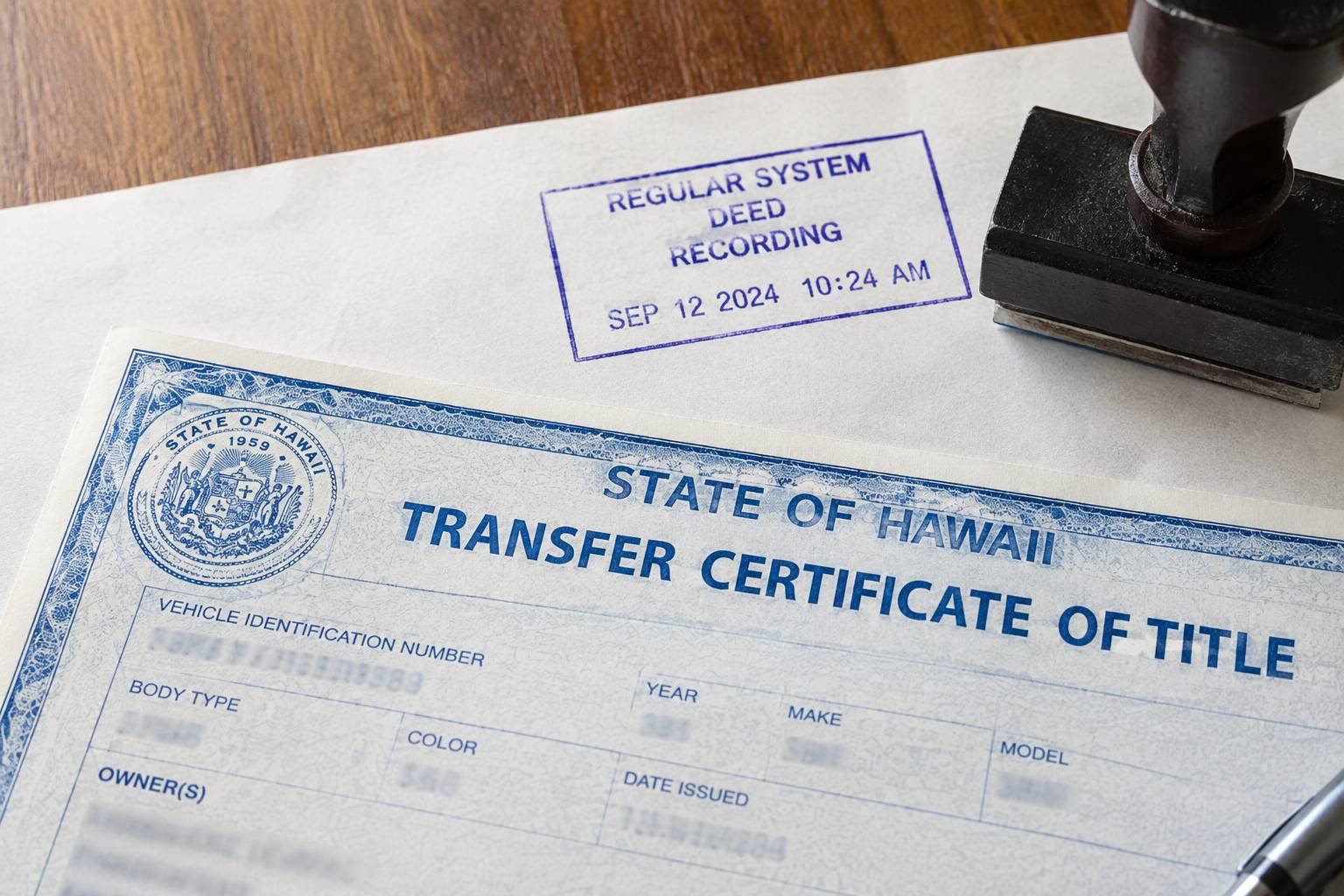
Modeled on the Torrens system and established in 1903, Land Court provides state certification of ownership. Once property is registered, the state issues a Certificate of Title (later updated as a Transfer Certificate of Title). Ownership and most encumbrances must be noted on that certificate to be effective. Title does not pass until the transfer is registered on the certificate. Adverse possession generally cannot defeat Land Court title. Changes such as name updates, marital status, or death of an owner often require a formal petition process before further conveyances can proceed.
Some properties are recorded in both systems (dual system). In those cases documents may need to be processed in both, which can add time and cost.
You can usually identify the system by looking at the prior deed: Regular System labels typically appear in the upper right corner, Land Court labels in the upper left. The preliminary title report will state the system clearly.
Land Court vs. Regular System Comparison
Feature | Regular System | Land Court System |
|---|---|---|
Nature | Race-notice; gives public notice | Torrens-style; state certifies ownership |
Ownership evidence | Chain of recorded documents | Certificate of Title / Transfer Certificate of Title |
Guarantee by State | No | Yes (subject to limited statutory exceptions) |
Adverse possession | Possible under Hawai‘i statutes | Generally not available |
Document changes (name, status, death) | Usually simpler documentation | Often requires petition and court review |
Recording process | Generally faster and more flexible | More formal review; can take longer |
Common document number format | Numeric (format varies by era) | Sequential numbers preceded by “T” |
Practical Implications for Buyers and Sellers
The recording system rarely determines whether a property is desirable, but it does affect process and timing. Land Court properties can require extra steps when ownership details on the certificate need updating. Dual-system properties may involve higher recording fees and slightly longer processing.
Title insurance is still recommended in both systems. It protects against certain defects that may not appear in the public record or that arise after closing.
Sellers should gather any prior deeds, existing Transfer Certificates of Title (if Land Court), and documentation of name or marital-status changes early. Buyers should review the preliminary title report promptly and raise questions through their advisor or escrow officer.
Areas We Serve and Property Expertise
Hawai‘i Modern Realty assists buyers and sellers across O‘ahu and the neighbor islands with transactions involving both Land Court and Regular System properties. Our advisors regularly handle:
Single-family homes and condominiums in all major O‘ahu neighborhoods
Properties near military installations and urban Honolulu
Fee-simple and leasehold transactions
Complex title or ownership situations that require clear coordination with escrow and title companies
Open-house strategy and comparative market analysis
Local knowledge of how the two systems operate in practice helps keep closings on track.
Why Working with Hawai‘i Modern Realty Is Different
We combine practical familiarity with Hawai‘i’s recording systems and escrow practices with modern tools and personalized guidance. Advisors help clients understand what appears on a title report, coordinate with escrow officers, and keep the process moving. The focus remains on clear communication and matching the transaction to each client’s goals.
With more than a decade of experience across Hawai‘i, over $2.7 billion in closed sales, and a team of 160-plus local advisors, we support buyers and sellers through the full transaction cycle.
Our Mortgage Calculator can help buyers estimate monthly payments while the title and escrow process moves forward.
Frequently Asked Questions
How do I know which system a property is in?
The preliminary title report will state it clearly. Prior deeds also show the system through the placement of the Bureau of Conveyances label and document numbering format.
Does the recording system affect the purchase price or desirability?
No. Both systems produce marketable titles when properly handled. The difference is mainly procedural.
Can a property move from Land Court to the Regular System?
Yes, under certain statutory procedures, though it is not automatic and typically requires legal guidance.
Why does Hawai‘i still use two systems?
Land Court was introduced in 1903 to provide a stronger form of title certainty for registered parcels. The Regular System continues for properties that were never registered and for many other types of documents.
What happens if there is a problem on the title report?
Escrow and the title company work with the parties to clear requirements. Common resolutions include payoff of liens, obtaining releases, or correcting ownership records through the appropriate system.
Is title insurance still necessary with Land Court property?
Yes. Title insurance covers risks beyond what the Certificate of Title addresses and is standard practice in Hawai‘i transactions.
Ready to Move Forward with Clear Expectations?
Understanding Hawai‘i’s escrow process and dual title systems removes much of the uncertainty that can accompany a real estate transaction. Knowing which system applies and what steps are required helps both buyers and sellers stay on schedule.
If you are preparing to buy or sell, connect with one of our local advisors. We can review current market conditions, explain how title and escrow typically unfold for properties in your area of interest, and coordinate with trusted escrow and title partners. Reach out today and let’s walk through the process together.