Table of Contents
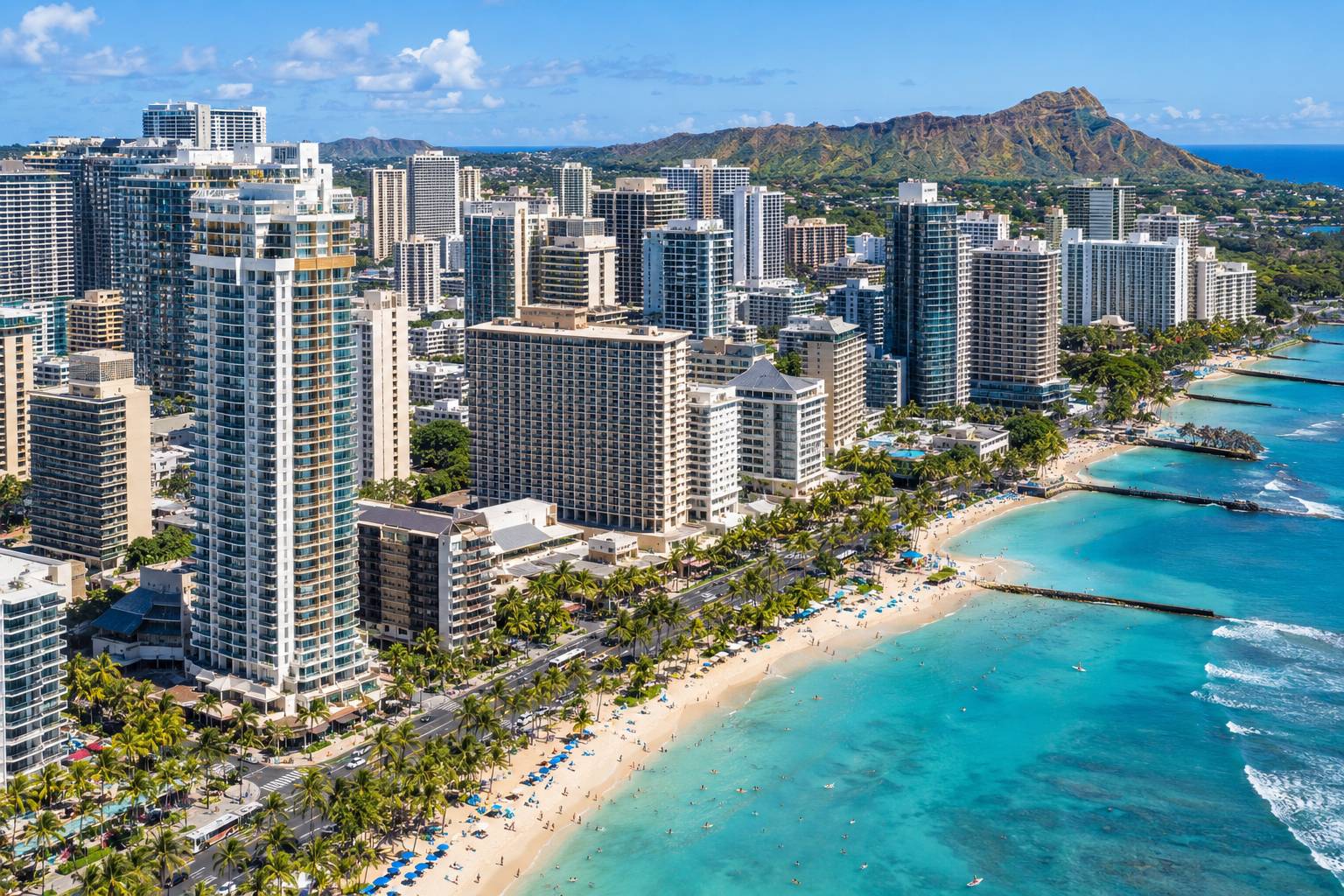
Waikīkī remains one of O‘ahu’s most active condo markets. Buyers drawn by location, walkability, and investment potential often face a web of zoning rules, short-term rental (STR) restrictions, and building-specific policies that differ sharply from mainland expectations. Understanding these layers before writing an offer protects both lifestyle plans and financial outcomes.
At Hawai‘i Modern Realty we help buyers navigate these details with clear local knowledge. The rules are specific, enforceable, and directly affect what you can and cannot do with a unit after closing.
Resort Zoning Versus Apartment Precinct in Waikīkī
Waikīkī sits inside a special district with distinct precincts. The two that matter most for residential buyers are the Resort Mixed-Use precinct and the Apartment precinct.
In the Resort Mixed-Use precinct, short-term rentals (stays under 30 consecutive days) are generally permitted as of right, subject to registration with the Department of Planning and Permitting (DPP) and any house rules set by the condominium association. Many hotel-condo and resort buildings fall here.
The Apartment precinct, largely mauka of Kūhiō Avenue, is more restrictive. New short-term rentals are limited to specific mapped parcels and buildings identified in city ordinances (including updates under Ordinance 25-52). Outside those designated areas, whole-unit short-term rentals are not allowed unless the unit carries a valid Nonconforming Use Certificate.
Always verify the exact zoning of a tax map key through the City and County of Honolulu’s official mapping tools or DPP before assuming STR potential.
Non-Conforming Use Certificates (NUCs): The Grandfathered Exception
A Nonconforming Use Certificate allows certain units to continue operating as transient vacation units even if current zoning would otherwise prohibit it. These certificates were issued for properties that were already legally renting short-term before October 22, 1986. The city stopped issuing new NUCs decades ago.
Key points for buyers:
An NUC runs with the unit but must be renewed annually (typically September 1 to October 15) by the owner.
Renewal requires proof of continuous operation and active GET and TAT licenses.
If the use is discontinued for 12 consecutive months (or 18 months within any three-year period), the certificate can be lost permanently.
Ownership transfer does not automatically guarantee uninterrupted status; the new owner must maintain compliance.
Units with active NUCs often command a premium because legal short-term income is scarce outside resort zones. Sellers are required under city ordinance to disclose whether a property may be legally used for short-term rentals.
Other Paths to Legal Short-Term Use
Beyond pure resort zoning and NUCs, a limited number of apartment-precinct buildings received specific carve-outs (for example, certain towers such as Waikīkī Banyan and Waikīkī Sunset under earlier ordinances). Some older buildings that meet the legal definition of a hotel under the Land Use Ordinance can operate as nonconforming hotels without individual NUCs.
Registration with DPP is still required for most new or continuing transient vacation unit operations in eligible zones. Fees apply, and the registration does not transfer automatically with ownership.
Buyer Realities Beyond the Rules
Even when zoning and NUC status look favorable, practical considerations remain:
Condominium association rules can prohibit or tightly limit short-term rentals regardless of city zoning. Review the house rules, bylaws, and any recent board resolutions carefully.
Property tax classification changes with use. Transient vacation or hotel classifications carry higher rates than residential. Long-term or owner-occupied use can qualify for lower residential rates if the proper declarations are filed.
Insurance, financing, and reserves differ for investment units versus primary residences. Lenders and insurers may treat STR properties under commercial guidelines.
Management costs for short-term operation typically run 20–25 percent of gross rental income plus cleaning, supplies, and platform fees.
Building conditions and special assessments are common in older Waikīkī towers. Spalling repairs, elevator upgrades, and plumbing projects appear frequently in older stock.
A buyer focused purely on long-term rental or personal use faces fewer restrictions but still benefits from verifying that the building’s rules and tax classification match the intended plan.
Quick Reference: Legal STR Paths in Waikīkī
Path | Where It Applies | Key Requirements | Transfer Notes |
|---|---|---|---|
Resort Mixed-Use zoning | Designated resort precinct lots | DPP registration; association rules must allow | Registration is owner-specific; re-register after purchase |
Valid NUC | Scattered apartment and residential units with pre-1986 history | Annual renewal; continuous operation proof | Certificate can be lost if use lapses |
Specific ordinance carve-outs | Named buildings/parcels (e.g., certain Waikīkī towers) | DPP registration where required | Confirm current map and ordinance status |
Nonconforming hotel status | Select older buildings meeting hotel definition | Building-level compliance | Unit rules still apply |
How to Evaluate a Waikīkī Condo as a Buyer
Start with the tax map key and pull the current zoning designation. Cross-check against the DPP short-term rental eligibility map. Request the seller’s STR disclosure form early. Review the condominium documents for rental restrictions, minimum lease terms, and any pending special assessments.
For investment buyers, model both short-term and long-term income scenarios after management fees, taxes, and vacancy. For lifestyle buyers, confirm parking, storage, noise levels, and proximity to preferred beaches or amenities.
Our Mortgage Calculator can help you estimate monthly carrying costs under different down-payment and rate assumptions. Pair that with a conversation about realistic net income after all local expenses.
Areas We Serve and Property Expertise
Hawai‘i Modern Realty works extensively with buyers in Waikīkī and surrounding urban Honolulu neighborhoods. Our advisors regularly assist with:
Condominiums and high-rise residences in Waikīkī, Ala Moana, and Kaka‘ako
Units with potential or existing short-term rental status
Long-term investment and primary-residence purchases
Luxury and ocean-view properties
Open-house strategy and comparative market analysis
Multi-family and mixed-use opportunities nearby
Local knowledge of building histories, association cultures, and micro-location differences helps buyers avoid costly assumptions.
Why Working with Hawai‘i Modern Realty Is Different
We combine deep familiarity with Waikīkī’s zoning layers and building-specific rules with modern tools, including AI-assisted search that lets you describe what you want in everyday language. Advisors help you verify STR eligibility, tax implications, and association restrictions before an offer is written. The focus stays on matching the property to your actual goals rather than simply closing a transaction.
With more than a decade of work across Hawai‘i, over $2.7 billion in closed sales, and a team of 160-plus local advisors, we provide practical guidance grounded in current city ordinances and market conditions.
Frequently Asked Questions
Can every condo in Waikīkī be rented short-term?
No. Only units in eligible resort-zoned areas, properties with valid NUCs, or specific ordinance-designated buildings can legally operate short-term. Association rules may add further limits.
What happens to an NUC when a unit is sold?
The certificate can continue if the new owner maintains compliance and renews on schedule. Any lapse in use or renewal can permanently eliminate the nonconforming status.
Do I need to register with the city even in a resort zone?
Yes, most transient vacation unit operations require registration with the Department of Planning and Permitting and payment of applicable fees.
How does short-term use affect property taxes?
Transient vacation or hotel classifications generally carry higher rates than residential. Owners who convert to long-term or primary residence use can apply for reclassification under city rules.
What should I request from the seller regarding STR status?
Ask for the required short-term rental disclosure form, any existing NUC documentation, current registration status, and the full condominium documents that address rental policies.
Are 30- to 89-day rentals treated differently?
City enforcement continues to focus on stays under 30 days as the primary short-term threshold. Certain pre-existing 30- to 89-day operations received court protection, but new activity outside eligible zones faces strict limits. Confirm current status with DPP for any specific unit.
Ready to Explore Waikīkī with Clear Eyes?
Waikīkī offers genuine opportunities for both lifestyle and investment buyers, provided the zoning, association rules, and intended use align. The difference between a smooth ownership experience and unexpected restrictions often comes down to verification before the contract is signed.
If you are considering a purchase in Waikīkī or nearby urban Honolulu neighborhoods, connect with one of our local advisors. We can help you review eligibility, model realistic costs, and identify properties that match your goals. Reach out today and let’s walk through the details together.