
Table of Contents
Hawai‘i property owners navigate one of the most distinctive tax environments in the United States. Rates for owner-occupied homes rank among the lowest nationally, yet the structure differs sharply from the mainland. County classifications, the General Excise Tax, conveyance tax tiers, and HARPTA withholding all influence the true cost of buying, owning, and selling real estate across the islands.
This guide outlines every major tax that touches Hawai‘i real estate transactions. It covers the semi-annual property tax bill, capital gains treatment, and the withholding rules that affect non-resident sellers. Understanding these details before you buy or sell protects both your timeline and your net proceeds.
Why Hawai‘i’s Property Tax System Operates Differently
Property taxes in Hawai‘i are assessed and collected at the county level. Each of the four counties sets its own rates and classification systems. Your Tax Map Key (TMK) identifies the parcel and determines which county rules apply.
Classification often matters more than location. An owner-occupied home in the Residential or Homeowner class pays the lowest rate. Investment properties, second homes, and short-term rentals move into higher tiers. The difference can triple the annual bill on the same assessed value.
Hawai‘i Modern Realty advisors regularly walk clients through these county-specific nuances before purchase offers are written. Local knowledge of classification rules and exemption deadlines helps buyers avoid costly surprises after closing.
Current Property Tax Rates and the Home Exemption Advantage
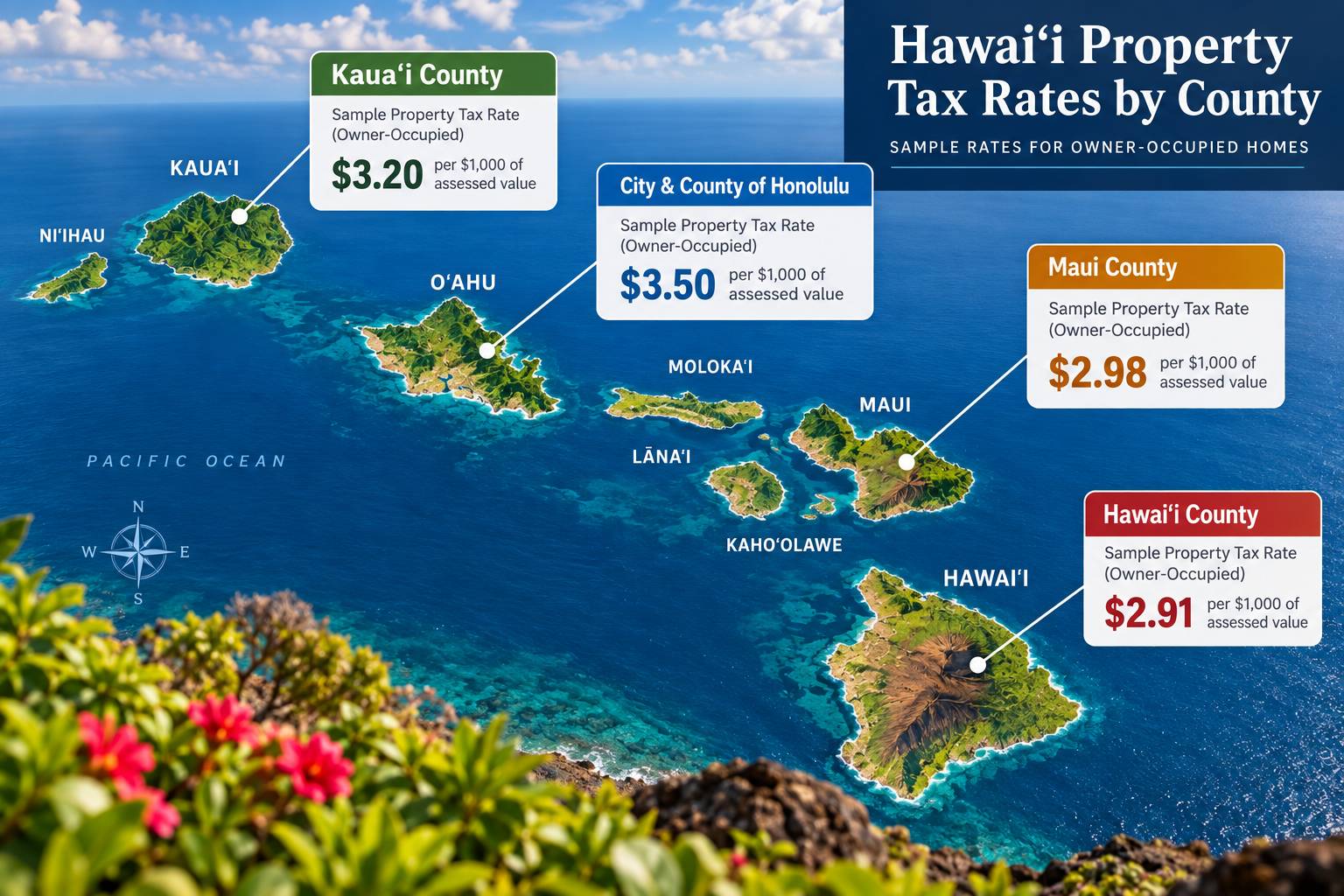
Rates are expressed per $1,000 of net taxable assessed value and change annually. Approximate owner-occupied rates for recent fiscal years illustrate the range:
County | Owner-Occupied / Homestead Rate | Non-Owner-Occupied / Higher Tier Example |
|---|---|---|
Honolulu (O‘ahu) | $3.50 (Residential with exemption) | Residential A tiers start higher |
Maui | Owner-occupied tiers near 1.80 | Non-owner tiers rise significantly |
Hawai‘i (Big Island) | $5.95 (Homeowner) | Residential Tier 1 near $11.10 |
Kaua‘i | Homestead near 3.05 | Non-owner and investor tiers higher |
Always verify the current schedule on your county’s real property tax website, as rates and tier thresholds are updated each year.
The home exemption reduces taxable assessed value for owners who occupy the property as their primary residence. Exemption amounts and senior add-ons vary by county. Qualification generally requires ownership and occupancy as of January 1, with an initial application deadline often around September 30 of the first year. Only one exemption is allowed statewide per person.
Missing the filing window in the first year of ownership can leave the property in a higher-rate classification until the following tax year. Advisors at Hawai‘i Modern Realty emphasize confirming classification and exemption status early in the ownership process.
Capital Gains When Selling Hawai‘i Property
Federal capital gains rules provide the familiar exclusion: $250,000 for single filers or $500,000 for married couples filing jointly, provided the property served as a primary residence for two of the last five years. Hawai‘i treats gains as ordinary income taxed at rates up to 11 percent. There is no preferential capital gains rate at the state level.
Cost basis includes the original purchase price plus capital improvements, purchase closing costs, and selling expenses such as commissions and escrow fees. Accurate documentation of improvements can meaningfully reduce the taxable gain.
Investment property owners may defer federal and Hawai‘i tax through a properly structured 1031 exchange. The replacement property must be identified within 45 days and acquired within 180 days. Primary residences generally do not qualify without a substantial prior investment holding period.
For a detailed look at related withholding rules, see Hawai‘i Modern Realty’s guide on Understanding HARPTA and FIRPTA When Buying or Selling O‘ahu Property. The firm has also published guidance on Understanding Hawai‘i 1031 Exchanges.
General Excise Tax and Conveyance Tax at Closing
Hawai‘i’s General Excise Tax (GET) applies to business gross receipts, not the property transfer itself. The statewide base rate is 4 percent, with a 0.5 percent county surcharge that brings the effective rate near 4.5 percent in most areas. Individual homeowners selling a personal residence typically do not owe GET on the sale proceeds. Real estate commissions, however, are subject to GET and appear itemized on closing statements.
Conveyance tax is calculated on the full consideration paid. Rates are tiered by sale price and by whether the buyer qualifies for a county homeowner’s exemption. Lower rates apply when the buyer is eligible for the exemption on a condominium or single-family residence. Higher rates apply to non-owner-occupied purchases and other property types. The tax is customarily paid by the seller, though allocation remains negotiable in the purchase contract.
Exemptions exist for certain transfers between spouses, documented family gifts, and foreclosure sales. Official rate details appear in Hawai‘i Revised Statutes Chapter 247. For current forms and guidance, consult the Hawai‘i Department of Taxation.
HARPTA Withholding for Non-Resident Sellers
Under the Hawai‘i Real Property Tax Act, buyers must withhold 7.25 percent of the gross sales price when the seller is not a Hawai‘i resident on the closing date. This amount is remitted to the Department of Taxation as an estimate against the seller’s eventual Hawai‘i income tax liability. It is not an additional tax.
For a $1 million sale, the withholding equals $72,500. Sellers can apply for reduced or eliminated withholding before closing by filing the appropriate forms (such as N-288C or related certifications) with supporting documentation. Exemptions or reduced withholding may apply in limited circumstances, including certain low-value primary residence sales or documented residency.
Refunds of excess withholding are claimed on the Hawai‘i tax return and typically process in several weeks to a few months after filing. Non-resident sellers should plan cash flow accordingly. Official information is available through the Hawai‘i Department of Taxation.
Investment Property and Short-Term Rental Obligations
Investment and non-owner-occupied properties pay higher property tax rates. Rental income is subject to Hawai‘i state income tax and GET on gross receipts. Short-term rentals (under 180 consecutive days) also trigger the Transient Accommodations Tax at 10.25 percent statewide, plus possible county surcharges.
Operators must obtain the required GET and transient accommodations licenses before advertising or accepting guests. County rules on short-term rental permits continue to evolve, with restrictions in many residential zones. Buyers considering rental strategies should confirm current zoning and permit availability before closing.
Deductible expenses for rental properties include mortgage interest, management fees, maintenance, insurance, and depreciation. Military families converting a primary residence to a rental after relocation often benefit from advisors familiar with both tax treatment and remote management realities.
For related context on second-home ownership costs, review Hawai‘i Modern Realty’s article on Buying a Second Home in Hawai‘i: Taxes & Tips.
Payment Deadlines and Assessment Appeals
Property taxes are due semi-annually across the counties, typically August 20 and February 20. Late payments incur a 10 percent penalty plus monthly interest. Most mortgage servicers handle payments through escrow. Owners without a mortgage should enroll in automatic payments through the county portal.
Assessment notices usually arrive in the spring. Owners generally have about 30 days from the notice date to file an appeal with the county Board of Review. Successful appeals commonly rest on comparable sales data, documented condition issues, or classification errors. County assessor websites provide sales data and neighboring assessments that support well-prepared appeals.
Why Hawai‘i Modern Realty Approaches These Details Differently
Hawai‘i Modern Realty is a locally owned brokerage that has guided more than 3,000 families and closed over $2.7 billion in sales across the islands. Advisors combine deep neighborhood knowledge with modern tools, including AI-powered search on modernhawaii.com that lets clients describe goals in everyday language.
The practical difference appears early. Advisors help clients model property tax classification impacts, estimate full carrying costs, and plan for HARPTA or conveyance tax before an offer is written. After closing, the team connects owners with trusted local resources for tax, management, and service needs. The focus remains on matching the property to the client’s actual lifestyle and financial objectives rather than simply completing a transaction.
Areas We Serve and Property Expertise
Hawai‘i Modern Realty works across the islands with particular strength on O‘ahu and expanding reach statewide. Advisors regularly assist clients with:
Condominiums and high-rise residences in Waikīkī, Ala Moana, and Kaka‘ako
Luxury single-family homes and oceanfront properties
Resort and second-home communities
Long-term and short-term rental properties where legally permitted
Open houses and select off-market opportunities
First-time island buyers, military relocations, and experienced investors
Neighborhoods and areas frequently requested include Honolulu, Kailua, Kapolei, ‘Ewa Beach, Kāne‘ohe, Mililani, and select communities on Maui, Kaua‘i, and Hawai‘i Island.
Before listing or refining your search, many sellers find value in estimating current market position with the firm’s home value tool. Buyers comparing payment scenarios can explore the mortgage payment calculator.
Frequently Asked Questions
How do I confirm my property’s current tax classification?
Review your most recent Notice of Assessment or contact the county real property tax office using your TMK. Classification determines the rate that applies.
Can I claim the home exemption on more than one property?
No. Only one homeowner exemption is allowed per person statewide.
Does HARPTA apply if I recently moved to the mainland?
Residency is determined as of the closing date. Former residents who no longer qualify as Hawai‘i residents for tax purposes are generally subject to the 7.25 percent withholding unless an exemption or reduced-withholding certificate is approved.
Who typically pays the conveyance tax?
Customarily the seller, though the parties may negotiate a different allocation in the purchase contract.
Are short-term rental permits still available?
Availability depends on the county and specific zoning. Many residential areas now restrict or prohibit new short-term rental activity. Confirm current rules before purchasing with rental income in mind.
What This Means for Your Next Transaction
Hawai‘i’s tax structure rewards owner-occupants, applies higher rates to investment use, requires 7.25 percent HARPTA withholding for most non-resident sellers, and varies by county. Calculating the full annual cost at the correct classification before purchase, and understanding HARPTA and capital gains treatment before sale, can protect tens of thousands of dollars.
Connect with a Hawai‘i Modern Realty advisor to review the specific implications for your property or search criteria. Local expertise, modern tools, and personalized guidance help you move forward with clarity. Visit our website or reach out to start the conversation.