.jpg)
Table of Contents
Searching property tax records in Hawai‘i is not as simple as opening a single statewide database. Each of the four counties—Honolulu, Hawai‘i, Maui, and Kaua‘i—maintains its own separate tax system with different portals, search interfaces, and data formats. Whether you are verifying an assessment before making an offer, checking payment history during due diligence, or researching comparable properties, you need to know which county system to access and how to extract the information that matters.
This guide walks through each county’s real property tax search process and shows how tax records help buyers and sellers make clearer decisions across the islands.
How Hawai‘i’s County-Based Tax System Works
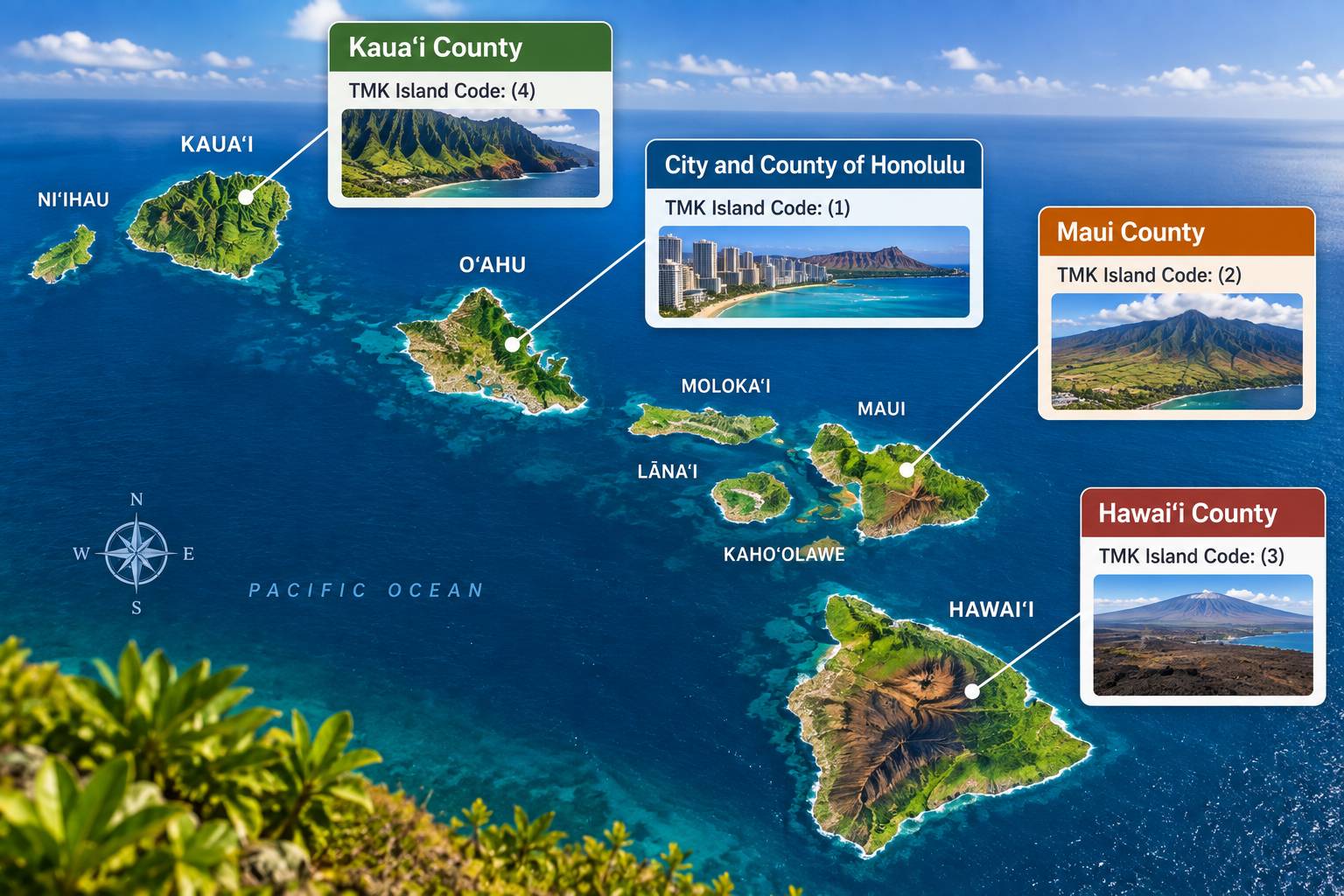
Hawai‘i has no statewide property tax database. The City & County of Honolulu, Hawai‘i County, Maui County, and Kaua‘i County each operate independent Real Property Assessment Divisions with separate online portals. Searching for a property on O‘ahu requires a completely different website and process than searching for one on Hawai‘i Island.
Every property in Hawai‘i is identified by a Tax Map Key (TMK), a unique parcel identifier formatted as Island-Zone-Section-Plat-Parcel. Island codes run from 1 (Hawai‘i) to 9 (Kalawao), with O‘ahu designated as 3. Across the state’s more than 660,000 parcels, these TMK numbers are the most reliable search tool when addresses return multiple results or rural properties lack standard street addresses.
Public records in each county typically include current assessed values, tax classifications (Residential, Hotel/Resort, Agricultural, and others), recent payment history, exemption status, and property characteristics such as square footage and lot size. Buyers use this data to verify sellers’ claims about taxes, check for delinquencies that could delay closing, and estimate future tax liability. Sellers and owners search records to identify assessment errors worth appealing or to pull comparable property data. For the more than 3,000 families Hawai‘i Modern Realty has served across all islands, understanding each county’s system helps avoid surprises during transactions.
Rates and classifications change annually. Always confirm the latest figures directly on the county portals before relying on any estimate.
Searching Honolulu County Tax Records (O‘ahu)
The City & County of Honolulu Real Property Assessment website covers approximately 350,000 parcels on O‘ahu. Start by selecting your search method. Street address works for most urban properties, but TMK searches eliminate ambiguity when multiple units share an address or when dealing with condominiums.
Once you pull up a property record, focus on these fields: the assessed value (which determines the tax bill), the tax classification, and any exemptions listed. Honolulu’s home exemption reduces assessed value for qualifying owner-occupants. Residential rates differ based on owner-occupancy and value tiers. Non-owner-occupied properties and higher-value homes fall into higher rate categories.
Check the payment history tab to confirm no delinquencies exist. Unpaid taxes become the buyer’s responsibility if not cleared at closing. Download the property record card if you need documentation for a lender or title company. For military families relocating to O‘ahu, verifying these details before purchase protects against unexpected increases when the property reassesses closer to the purchase price.
Reading Your Honolulu Assessment Notice
Assessment notices are mailed annually. The assessed value reflects the assessor’s estimate of market value as of a prior valuation date, which means it can lag actual market conditions. Properties that sell well above their assessed value often see noticeable tax increases in the following cycle.
If your notice shows an assessed value significantly higher than comparable properties or includes incorrect square footage, you generally have a limited window from the mailing date to file an appeal with the Board of Review. Strong appeals usually require documentation such as recent appraisals, multiple comparable properties with lower assessments, or evidence of condition issues not reflected in the assessment. Missing the deadline typically locks the value in until the next annual cycle.
Official information is available through the City and County of Honolulu Real Property Assessment Division.
Hawai‘i County and Maui County Tax Searches
The Hawai‘i County Real Property Tax portal covers roughly 180,000 parcels across Hawai‘i Island. The interface differs from Honolulu’s system. Search results often display more prominently on a map view, which helps when researching adjacent parcels or verifying property boundaries in rural areas.
Hawai‘i County’s homeowner rate is substantially higher than Honolulu’s base rate for owner-occupied properties. Non-owner-occupied residential properties pay still higher rates, sometimes structured in tiers based on value. Verify the tax classification carefully. An incorrect non-owner-occupied classification when a property should qualify for the homeowner rate can add hundreds of dollars annually.
Maui County’s system serves approximately 85,000 parcels across Maui, Moloka‘i, and Lāna‘i. Search results clearly indicate which island each property sits on. This matters when researching comparables, because Moloka‘i and Lāna‘i properties often assess lower than similar Maui properties due to limited services and market demand. Owner-occupied residential properties generally carry lower rates than non-owner-occupied ones. Download payment history directly from the portal when you need documentation for refinancing or title work.
Rates are set annually by each county council. Confirm current figures on the official county sites before calculating estimated liability.
Kaua‘i County Searches and What Tax Records Reveal Before You Buy
Kaua‘i County’s real property portal covers about 45,000 parcels. Residential homestead rates are lower than non-homestead rates. Agricultural designations carry different rates entirely, and classification disputes arise when properties sit near the line between agricultural use and residential estates.
Kaua‘i’s microclimates create assessment challenges. North Shore properties can face higher maintenance costs from rainfall and humidity, while South Shore properties often command premiums for more consistent weather. These factors should appear in comparable property analysis, yet assessors sometimes group properties broadly. Local knowledge helps recognize when an assessment does not fully reflect location-specific conditions.
Before making an offer anywhere in Hawai‘i, pull tax records to identify these red flags:
Payment delinquencies in the past two years, which can signal financial distress or title issues
Recent classification changes that may indicate zoning questions or unpermitted use
Assessed values significantly below recent comparable sales, which often precede sharp increases after reassessment
Most importantly, calculate estimated tax liability based on your likely purchase price rather than the seller’s current bill. If a property assessed at $700,000 sells for $1 million, the next assessment cycle will likely move the assessed value toward the new sale price. That shift can raise the annual tax bill by a meaningful amount. Verify whether the seller’s exemptions transfer (they do not automatically) and apply for any available home exemption promptly after purchase to capture the savings.
Professional guidance through this analysis is especially useful for military families working against PCS timelines who cannot afford closing delays from tax lien surprises.
Correcting Errors and Avoiding Tax Scams
If your assessment notice shows incorrect square footage, wrong bedroom counts, or a tax classification that does not match actual use, you may have grounds for appeal under Hawai‘i Revised Statutes Chapter 232. Deadlines are strict and vary slightly by county, but most require action within a short window after the notice date. Gather evidence such as recent appraisals, three to five comparable properties with lower assessments, photos documenting condition issues, and repair estimates for significant defects.
All four counties follow similar general timelines: notices are mailed, appeals are due within a defined period, and hearings occur later in the year. Success rates for appeals are modest. The strongest cases involve clear factual errors or substantial data showing the assessment exceeds similar properties by a meaningful margin.
Separately, homeowners have reported property tax scams that mimic official county correspondence. Fraudulent “house auction” notices claim the property will be sold for unpaid taxes and demand immediate payment by wire transfer or gift card. Legitimate county communications do not demand instant payment through those channels and do not threaten auction without formal process. Hawai‘i’s actual delinquency timeline is measured in years, not days or weeks.
Verify any concerning notice by logging into the county’s tax portal directly with the TMK number, or contact the county real property tax office Report suspicious communications to both the county and the Office of Consumer Protection.
Why Working with Hawai‘i Modern Realty Makes a Difference
Navigating four separate county systems while analyzing assessment data, classification nuances, and reassessment implications benefits from local expertise. Hawai‘i Modern Realty is a locally owned brokerage that has guided more than 3,000 families across the islands. The team combines deep neighborhood knowledge with modern tools, including AI-powered search on modernhawaii.com that lets buyers describe what they want in everyday language.
Advisors help evaluate tax classification implications, estimate realistic carrying costs, and identify red flags before an offer is written. This practical support is especially valuable for mainland buyers, military families, and investors who are less familiar with Hawai‘i’s county-by-county systems. Personalized guidance and local insight reduce the chance of tax-related surprises at closing or in the first year of ownership.
For a clearer picture of monthly costs that include property taxes, try the mortgage payment calculator on the Hawai‘i Modern Realty site. It helps model how different purchase prices and tax assumptions affect overall affordability.
Sellers can start with a home value estimate to understand how current assessed values compare with market expectations. Readers interested in second-home or investment property tax considerations may also find the related guide on buying a second home in Hawai‘i useful.
Areas We Serve and Property Expertise
Hawai‘i Modern Realty works across the islands with particular strength on O‘ahu and growing reach statewide. Advisors regularly assist clients with:
Condominiums and high-rise residences in Waikīkī, Ala Moana, and Kaka‘ako
Luxury single-family homes and oceanfront properties
Resort and second-home communities
Long-term and short-term rental properties where legally permitted
Open houses and off-market opportunities
First-time island buyers and experienced mainland investors
Key Differences Across Counties
County | Approx. Parcels | Primary Search Tip | Owner-Occupied Rate Tendencies | Non-Owner-Occupied Notes |
|---|---|---|---|---|
Honolulu (O‘ahu) | ~350,000 | Address or TMK; strong urban data | Lower base rates + exemptions | Higher tiers for non-owner and high-value |
Hawai‘i Island | ~180,000 | Map view helpful for rural parcels | Higher than Honolulu | Tiered rates often apply |
Maui | ~85,000 | Note island (Maui/Moloka‘i/Lāna‘i) | Among the lower owner rates | Steeper non-owner and STR tiers |
Kaua‘i | ~45,000 | Watch agricultural classifications | Homestead rates available | Non-homestead and vacation tiers higher |
Rates change annually. Always verify current figures on the official county portals.
FAQ: Hawai‘i Property Tax Records
What is a TMK and why does it matter?
A Tax Map Key is the unique parcel identifier used across Hawai‘i. It is more reliable than street addresses when searching rural properties, condominiums, or parcels with multiple units.
Do seller exemptions transfer to the buyer?
No. Homeowners and other personal exemptions generally do not transfer automatically. New owners usually must apply within a set period after purchase to claim available exemptions.
How soon after purchase will the assessed value change?
Assessments are updated annually based on a prior valuation date. A sale well above the previous assessed value commonly leads to a higher assessment in the next cycle.
What should I do if I receive a notice claiming my property will be auctioned?
Do not respond with payment. Log into the official county tax portal using the TMK or call the county office using a number you look up independently. Report the notice to the county and the Office of Consumer Protection.
Where can I find official county portals?
Start with the City and County of Honolulu Real Property Assessment Division site and the corresponding real property tax pages for Hawai‘i County, Maui County, and Kaua‘i County. Use official .gov or county domains only.
Next Steps
Start by searching your target property’s tax records in the appropriate county portal using the TMK number or address. Compare the assessed value and tax classification against similar properties, verify that no payment delinquencies exist, and calculate estimated taxes based on your likely purchase price rather than the current owner’s bill. If you are buying, request several years of tax history from the seller and confirm exemption eligibility before closing.
Navigating four separate county systems while analyzing assessment data and reassessment implications takes local knowledge. Contact a Hawai‘i Modern Realty advisor for guidance on interpreting tax records across the islands and protecting your investment from assessment surprises. The team is ready to help you move forward with clearer information and greater confidence.