Table of Contents
Moving to Hawai‘i comes with an important housing decision: should you rent first or buy a home right away?
Renting gives you time to understand a new neighborhood without making a long-term commitment. Buying can provide more housing stability and an opportunity to build equity, but it also comes with upfront expenses and responsibilities that vary by property.
The right choice depends on your finances, how long you expect to stay, and how well you understand the local housing market.
At Hawai‘i Modern Realty, we've helped more than 3,000 families buy and sell homes across the islands. We understand that finding the right property is about more than the asking price. It's about choosing a home that fits your life and financial plans.
In this guide, we'll explain the practical differences between renting and buying in Hawai‘i, what costs to compare, and how to decide which approach makes sense for your move.
Should You Rent or Buy When Moving to Hawai‘i?
Neither option is automatically better.
Renting may make more sense if you're unfamiliar with the island, uncertain about your long-term plans, or want flexibility while adjusting to a new location.
Buying may be worth exploring if you expect to stay for several years, have the financial resources for ownership, and have identified a community that fits your needs.
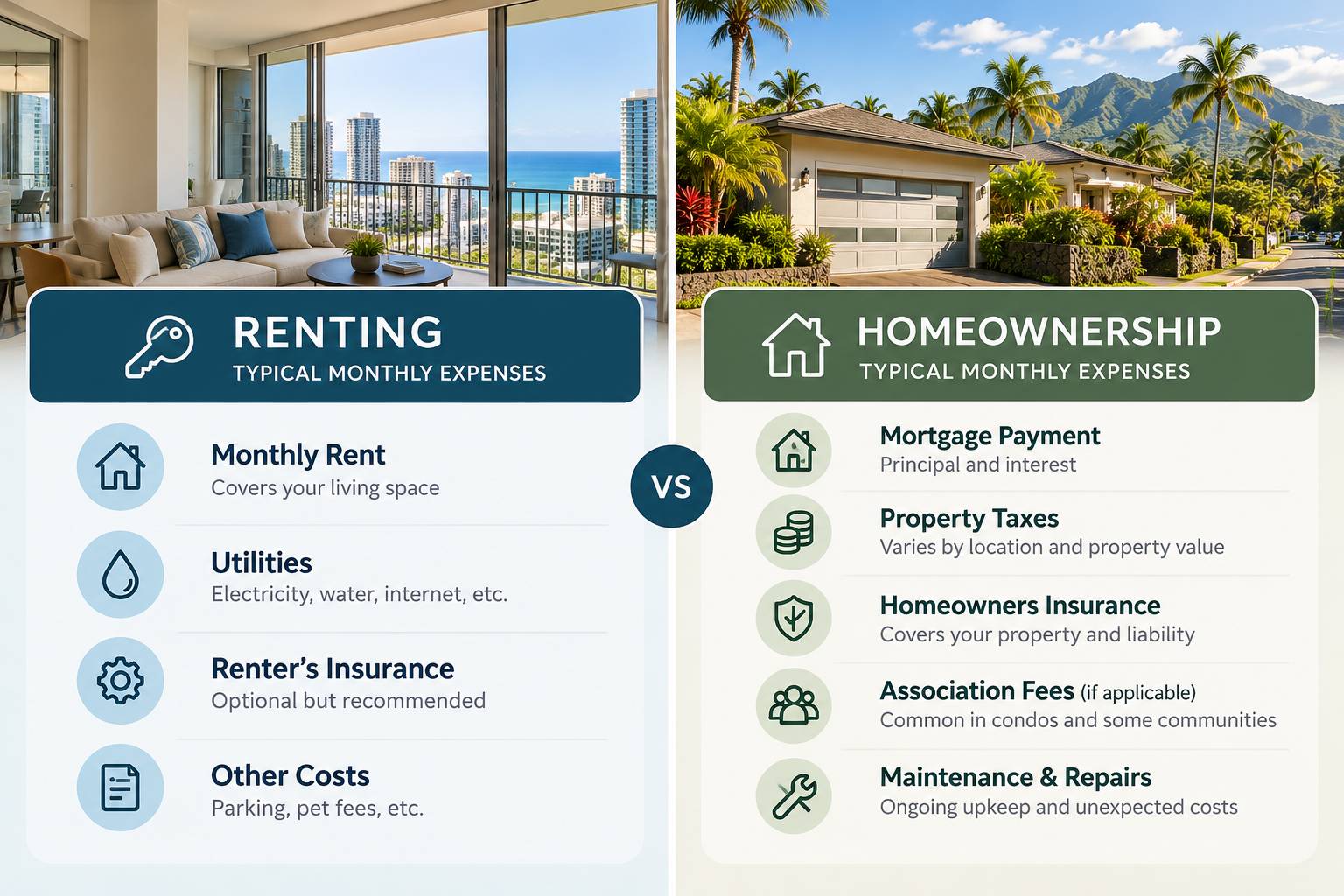
Consider these differences:
Factor | Renting | Buying |
|---|---|---|
Upfront expenses | Security deposit and applicable move-in costs | Down payment, closing costs, inspections, and other transaction expenses |
Monthly payments | Rent and any separately billed utilities or fees | Mortgage, taxes, insurance, maintenance, and applicable association fees |
Flexibility | Easier to relocate at the end of a lease | Selling involves transaction costs and market conditions |
Maintenance | Often handled by the landlord, subject to the lease and law | Generally the owner's responsibility |
Equity | Rent payments do not build ownership equity | Mortgage principal payments may build equity |
Long-term costs | Rent may increase over time | Some ownership costs may increase, even with a fixed-rate mortgage |
One important distinction is that buying does not guarantee appreciation or lower monthly costs.
Your decision should reflect your expected time in Hawai‘i, available savings, and the financial tradeoffs of each option.
Why Renting First Can Be a Smart Relocation Strategy
If you're moving from the mainland or another island, renting first can give you an opportunity to experience daily life before purchasing a home.
A neighborhood that looks ideal online may feel different once you're navigating its roads, shopping for groceries, or commuting during peak hours.
Get to Know Your Commute
Driving distances in Hawai‘i don't always tell the whole story.
On O‘ahu, a commute between West O‘ahu and urban Honolulu can vary considerably depending on traffic and departure time.
If you're relocating for work, consider how different neighborhoods fit your schedule.
Before committing to a property, try traveling the route during the hours you would normally commute.
Understand the Neighborhood
Renting can help you evaluate factors that aren't always obvious from listing photos:
Street noise and surrounding activity
Parking availability
Access to shopping and daily necessities
Building rules and maintenance conditions
The overall pace of the neighborhood
For example, urban condominium living in Kaka‘ako offers a different experience from living in a single-family neighborhood in Kailua.
Neither is inherently better. The right environment depends on your priorities.
Keep Your Options Open
Renting may be especially practical if your employment situation, household needs, or expected length of stay could change.
You can explore different communities without immediately taking on the costs of buying and potentially selling a property.
However, renting also has limitations. Lease terms may restrict pets or property modifications, and renewal terms may change.
The goal is to understand what flexibility is worth to you.
When Buying a Home in Hawai‘i May Make More Sense
For households planning to establish longer-term roots, buying can be an appealing alternative.
Homeownership offers more control over your living space and the potential to build equity over time.
But purchasing property in Hawai‘i requires careful financial planning.
You Expect to Stay Long Enough to Justify the Costs
Buying generally involves more upfront expenses than renting.
Beyond the down payment, buyers may need to account for lender fees, escrow charges, inspections, and other closing expenses.
If you expect to relocate again soon, those costs may outweigh the financial benefits of ownership.
There is no universal number of years that makes buying worthwhile. The answer depends on the property, financing, future market conditions, and the costs of eventually selling.
You're Financially Prepared for More Than a Mortgage Payment
A mortgage payment is only part of the cost of owning a home.
Depending on the property, you'll also need to consider:
Property taxes
Homeowners insurance
Flood insurance, when applicable
Condominium maintenance fees or HOA assessments
Utilities
Repairs and ongoing maintenance
Potential special assessments
These expenses can change over time.
We encourage buyers to evaluate the complete cost of ownership rather than focusing only on the property's listing price.
You've Found the Right Community
Buying becomes more compelling when you're confident about where you want to live.
That means understanding the neighborhood, property type, and practical considerations that could affect your experience.
Our Hawai‘i homebuying resources are a useful starting point for exploring the process.
Comparing the True Cost of Renting and Buying
A meaningful comparison starts with the same question for both options:
What will this home actually cost me each month, and what will I need to pay upfront?
Calculate Your Total Rental Costs
Suppose you're comparing several rental properties.
Don't evaluate them by advertised rent alone.
Consider whether the monthly amount includes electricity, water, internet, parking, or other expenses.
For condominium rentals, ask about move-in procedures, building restrictions, and any applicable fees.
You should also understand the security deposit, lease length, and renewal terms before signing.
Calculate Your Total Ownership Costs
For a home purchase, begin with the expected mortgage payment.
Then add property taxes, insurance, maintenance, and any applicable association fees.
A condominium with a lower purchase price may have substantial monthly maintenance fees. A single-family home may have no condominium fees but require more direct spending on repairs.
The appropriate comparison is the total expected cost of each property.
Use Our Hawai‘i Mortgage Calculator
If you're considering buying, our mortgage calculator can help you begin estimating your potential mortgage payment.
You can use it to explore how different home prices, down payments, and loan assumptions affect your budget, subject to the calculator's available inputs.
Remember that an estimate is not a mortgage approval or a complete ownership-cost calculation.
You'll still need to account for expenses such as property taxes, insurance, and applicable maintenance fees if they aren't included in the estimate.
Our recommendation: Compare your realistic rental budget with your estimated total ownership costs before deciding which path to pursue.

Hawai‘i-Specific Factors That Can Affect Your Decision
Buying property in Hawai‘i introduces considerations that may be unfamiliar to people relocating from elsewhere.
Understanding them early can help prevent surprises.
Fee Simple vs. Leasehold Ownership
Not every Hawai‘i property includes ownership of the underlying land.
With fee simple ownership, the buyer generally owns both the property and the land, subject to applicable legal restrictions.
With leasehold ownership, the buyer acquires an interest governed by a land lease, which may include ground rent, expiration dates, and other conditions.
Leasehold properties can have different financing and resale considerations.
Before comparing a leasehold condominium with a fee simple property, understand what is actually being purchased.
Condominium Maintenance Fees
Condominium ownership often includes monthly maintenance fees covering certain shared expenses.
Depending on the building, these may contribute to common-area upkeep, insurance, utilities, and reserve funding.
Fees alone don't reveal whether a building is financially healthy.
Buyers should also review available association documents, reserve information, insurance coverage, and any anticipated assessments.
Insurance and Property Risk
Insurance requirements can affect affordability and financing.
A property's location may also introduce exposure to flooding, tsunami hazards, lava flows, or coastal erosion.
The relevant risks differ by island and neighborhood.
Before purchasing, review the property's location using official resources such as the FEMA Flood Map Service Center and discuss insurance availability with a qualified provider.
Property Taxes
Property taxes vary by county and may depend on property classification, assessed value, and applicable exemptions.
The current owner's tax bill may not accurately represent what a new buyer will owe.
Include a realistic property-tax estimate when comparing homes.
Renting vs. Buying for Military Relocation
Military households often face additional timing considerations.
A permanent change of station (PCS) can create a relatively short window for arranging housing.
Renting may provide flexibility when you're unfamiliar with the island or uncertain about future assignments.
Buying may be worth exploring when your expected time in Hawai‘i and financial circumstances support the commitment.
Compare Housing Costs With Your BAH
Basic Allowance for Housing (BAH) is determined by factors including duty location, pay grade, and dependent status.
Your actual housing expenses may be higher or lower than your allowance.
Use the Department of Defense BAH calculator to check the applicable rate.
Then compare that amount with realistic rental costs or the full estimated cost of ownership.
Understand Your VA Loan Options
Eligible service members and veterans may be able to purchase a home using VA-backed financing.
VA loans can offer advantages, including no down payment for many eligible borrowers, but qualification and property requirements still apply.
The U.S. Department of Veterans Affairs explains eligibility and loan benefits.
Our team works with military relocation clients and can help buyers explore residential properties that fit their plans.
A Practical Checklist Before Making Your Decision
Before choosing between renting and buying, work through these questions:
How long do you expect to stay? Consider whether your plans are stable or likely to change.
How much cash do you have available? Account for upfront expenses without exhausting your emergency savings.
What is your complete monthly budget? Include costs beyond rent or mortgage payments.
How familiar are you with the neighborhood? Think about commuting, property conditions, and daily routines.
What type of property fits your needs? Compare condominiums, townhomes, and single-family homes.
How much financial flexibility do you want? Consider repairs, market changes, and future relocation costs.
If you're still uncertain, renting while learning the market can be a reasonable decision.
If you've identified the right community and your finances support a purchase, it may be time to explore ownership.
Why Work With Hawai‘i Modern Realty?
Buying a home in Hawai‘i requires more than finding an attractive listing.
Different islands, neighborhoods, and property types introduce different questions about ownership, financing, and long-term costs.
We're a locally owned, independent brokerage with more than a decade of experience helping families buy and sell homes across Hawai‘i.
Our approach combines local market knowledge with modern real estate tools and personalized guidance.
We're also part of Leading Real Estate Companies of the World®, a global real estate network that supports connections beyond our local market.
Whether you're relocating from the mainland, purchasing your first home, or exploring a luxury property, our goal is to help you make a well-informed decision.
Our residential expertise includes:
O‘ahu communities: Honolulu, Kaka‘ako, Kailua, Kāne‘ohe, Kapolei, ‘Ewa Beach, Mililani, Kahala, and Hawai‘i Kai
Other islands: Residential property opportunities on Maui, Kaua‘i, and Hawai‘i Island
Property types: Condominiums, townhomes, single-family residences, and luxury properties
Buyer needs: First-time homebuying, military relocation, individual and family relocation, and investment property purchases
We can help you evaluate available properties and understand how local market conditions may affect your purchase.
Frequently Asked Questions
Is it cheaper to rent or buy a home in Hawai‘i?
It depends on the property, financing, rental rates, and how long you expect to stay. Renting often involves lower upfront costs, while buying introduces the potential to build equity. Compare total costs rather than just monthly rent and mortgage payments.
Should I rent before buying a home on O‘ahu?
Renting first can be useful if you're unfamiliar with O‘ahu's neighborhoods or uncertain about your long-term plans. However, buyers who already know their preferred location and have stable finances may decide to purchase sooner.
Can I buy a home in Hawai‘i while living on the mainland?
Yes. Buyers can begin researching properties and discussing financing before relocating. Depending on the transaction and participating professionals, some steps may be completed remotely. Inspection arrangements and closing requirements should be confirmed for the specific purchase.
Are Hawai‘i condominiums more affordable than single-family homes?
Some condominiums have lower purchase prices than comparable single-family homes, but that doesn't necessarily make them less expensive to own. Maintenance fees, insurance, financing requirements, and special assessments can materially affect the overall cost.
How much should I save before buying a home in Hawai‘i?
Your savings needs depend on the purchase price, loan program, closing expenses, and emergency reserves. Some eligible buyers may qualify for low-down-payment or no-down-payment financing. A lender can help you understand the funds required for your circumstances.
Ready to Explore Buying a Home in Hawai‘i?
You don't need to decide whether to rent or buy based on listing prices alone.
Understanding your budget, preferred neighborhoods, and long-term plans can help you choose the path that makes sense for your move.
At Hawai‘i Modern Realty, we're here to help you explore the buying side of that decision with local knowledge and practical guidance.
Start with our Hawai‘i homebuying resources, or connect with our team to discuss your property goals.
Call 808-320-1244 or email aloha@modernhawaii.com to speak with our team.
Find your place in Hawai‘i with confidence.