Table of Contents
Check the Solar Equipment, Roof, and Maintenance Responsibilities
Frequently Asked Questions About Buying a Home With Leased Solar
A home with rooftop solar can be attractive in Hawaiʻi, where electricity costs are an important part of household budgeting. But before you make an offer, find out whether the seller owns the solar panels or has a contract with a third-party provider.
When solar equipment is leased or operated under a power purchase agreement (PPA), buying the home may involve taking on an existing contract. That agreement can affect your monthly expenses, financing, and future resale plans.
At Hawaiʻi Modern Realty, we help buyers look beyond the listing photos and understand the details that matter before closing. As a locally owned, independent brokerage that has guided more than 3,000 families, we combine local real estate knowledge with modern tools and personalized guidance.
Here's what to check when buying a home with leased solar panels in Hawaiʻi.
First, Find Out Who Owns the Solar Panels
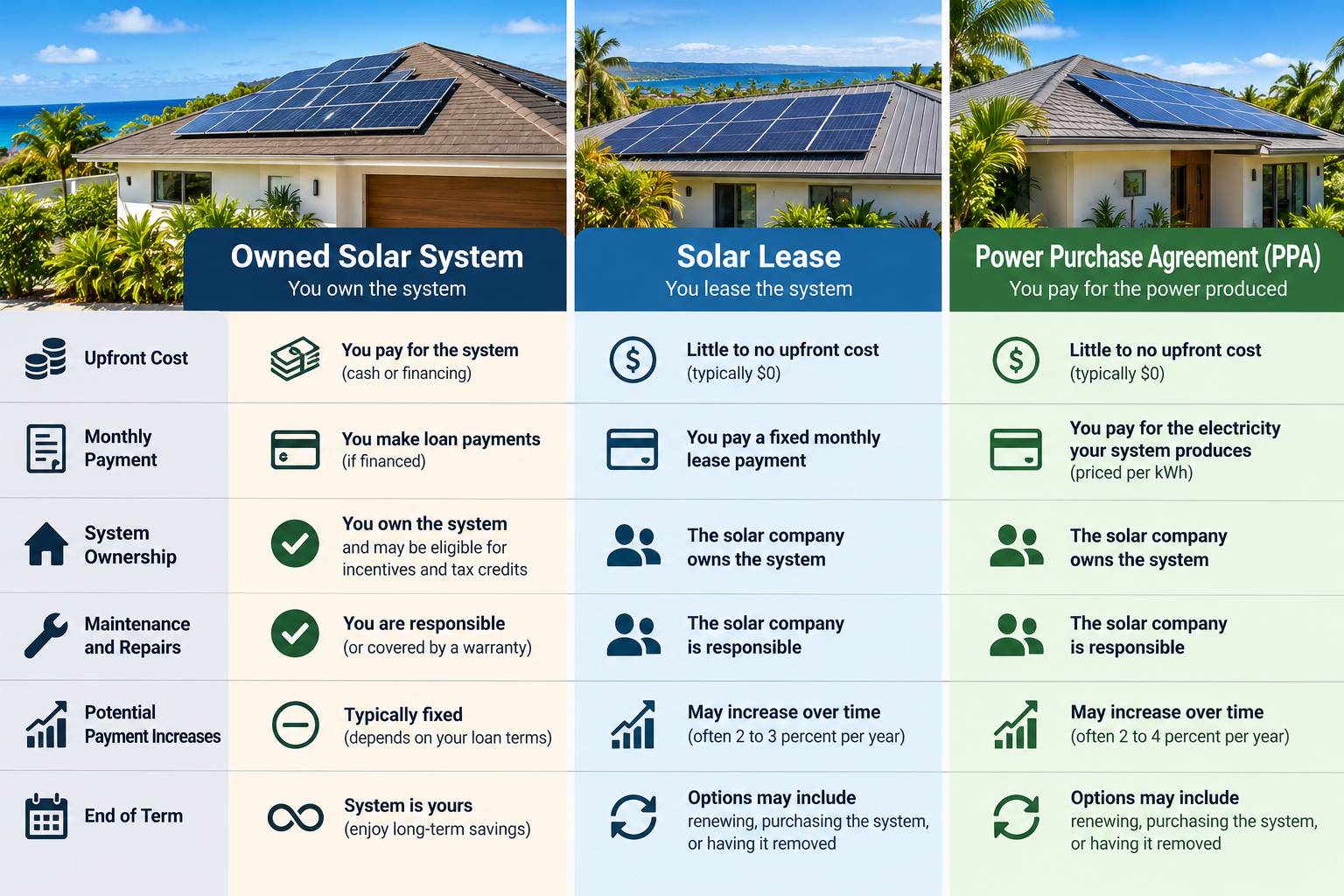
Not every home with solar has the same ownership arrangement. The equipment may be owned outright, financed through a loan, leased, or operated under a PPA.
Understanding the difference is the first step.
Solar arrangement | Who owns the equipment? | What buyers should check |
|---|---|---|
Owned outright | Generally the homeowner | Proof of ownership, warranties, equipment condition |
Solar loan | Generally the homeowner, subject to financing terms | Outstanding loan balance and any required payoff |
Solar lease | Third-party solar provider | Monthly payments, remaining term, transfer requirements |
Power purchase agreement | Third-party system owner | Electricity purchase rate, increases, and transfer conditions |
A solar lease typically involves payments for using the equipment. Under a PPA, the homeowner purchases electricity generated by the system at a contractually specified rate.
The Federal Trade Commission's solar consumer guide explains these arrangements and the contractual questions consumers should consider.
A listing that advertises solar panels doesn't necessarily tell you which arrangement applies.
Before making an offer, request the complete solar agreement and any amendments.
What Happens to a Solar Lease When You Buy the Home?
A solar lease or PPA doesn't automatically disappear when the property changes ownership.
Depending on the contract, the seller may need to transfer the agreement, purchase the system, or resolve the remaining contractual obligations before closing.
Understand the transfer requirements
Ask the solar provider to confirm:
Whether the agreement can transfer to a new homeowner.
Whether the buyer must meet credit or other approval requirements.
What documents are required to complete the transfer.
Whether transfer fees apply.
Who remains responsible if the transfer isn't completed.
Whether the system can be purchased outright.
Some providers have established transfer procedures. Others may require additional approvals.
Don't assume the seller's verbal assurance is enough. Obtain the provider's written requirements and coordinate them with your lender and escrow team.
Check the utility agreement separately
A solar provider's contract and the electric utility's interconnection agreement are not necessarily the same document.
For properties served by Hawaiian Electric, the utility provides specific guidance on transferring properties with rooftop solar systems.
Its guidance explains that new property owners assume the existing utility program agreement's applicable rights and responsibilities.
Buyers should confirm the property's utility provider and the specific program governing its solar installation.
This distinction matters because transferring a private solar contract does not, by itself, resolve every utility-related question.
Review the Monthly Payments and Future Increases
A solar installation may reduce the amount of electricity purchased from the utility, but that doesn't mean the system has no ongoing cost.
For leased systems, review the monthly payment schedule. For PPAs, examine the price charged for each unit of electricity produced.
Pay particular attention to annual increases or scheduled payment adjustments.
Compare the complete electricity cost
Consider a hypothetical home with the following monthly expenses:
Expense | Illustrative monthly amount |
|---|---|
Solar lease payment | $150 |
Remaining utility bill | $90 |
Combined monthly electricity expense | $240 |
In this example, the household pays $240 per month for electricity-related costs, not simply the $90 utility bill.
These amounts are illustrative, not estimates of typical Hawaiʻi solar expenses.
Request actual billing records and the solar provider's payment history. Compare them with the contract's future payment schedule.
Household consumption also matters. A seller's electricity usage may differ considerably from yours, particularly if your household uses more air conditioning or charges an electric vehicle.
What happens when payments increase?
Some agreements include annual payment increases, sometimes called escalators.
Even a modest increase can become meaningful over a long contract term.
Ask for the complete payment schedule rather than relying on the current monthly amount.
You should also determine whether the agreement offers a purchase option and how that price is calculated.
Check the Solar Equipment, Roof, and Maintenance Responsibilities
The contract isn't the only consideration.
Rooftop solar equipment is attached to a major component of the home, so buyers should understand the condition of both the system and the roof.
Who pays for repairs?
Review the agreement to determine which party is responsible for:
Solar panel repairs and replacement.
Inverter or battery maintenance.
Monitoring and system performance.
Roof access and equipment removal.
Damage associated with installation or maintenance.
Reinstallation following roof repairs.
A provider may handle certain equipment maintenance while leaving other responsibilities with the homeowner.
The specific contract controls.
What if the roof needs replacement?
This is an especially important question for homes with aging roofing materials.
If panels must be temporarily removed to repair or replace the roof, the provider may require an authorized contractor to perform the work.
That can affect project scheduling and cost.
Before purchasing, request available roof inspection records, installation permits, and equipment documentation.
Arrange appropriate independent inspections when needed.
If the property includes battery storage, ask about its age, warranty, operating condition, and whether ownership or maintenance obligations differ from those for the panels.
How Leased Solar Panels Can Affect Mortgage Financing
A home with leased solar may still qualify for mortgage financing, but lenders need to understand the contractual arrangement.
Different loan programs and individual lenders can impose different requirements.
A lender may review:
Whether the buyer must assume ongoing payments.
Whether those payments affect debt-to-income calculations.
Whether the solar provider has recorded a financing statement or other notice.
Whether the contract allows equipment removal.
Whether the agreement satisfies applicable loan-program requirements.
Don't wait until the final stages of escrow to disclose the solar arrangement.
Provide the complete contract to your lender early so financing questions can be addressed before closing.
What about VA buyers?
Military families and other eligible borrowers using VA financing should discuss the solar arrangement with their lender before making an offer.
A property's solar agreement may create documentation or underwriting questions that need to be resolved alongside the usual mortgage requirements.
The VA home loan program provides general information about eligibility and financing.
We recommend confirming how the specific agreement will be treated rather than assuming all leased systems receive the same treatment.
Compare Homes Using the Total Cost of Ownership
A home with solar should be evaluated using the same financial discipline as any other property.
The advertised asking price doesn't capture every expense associated with ownership.
Along with the mortgage payment, consider property taxes, insurance, association fees, maintenance, and any separate solar payments.
Use our Hawaiʻi mortgage calculator
Our mortgage calculator is the most relevant Hawaiʻi Modern Realty tool for this topic.
Use it to explore estimated mortgage payments based on purchase price, down payment, interest rate, and loan term.
Then add any solar lease or PPA payments that aren't included in the calculator's estimate.
This helps you compare a property with third-party-owned solar against another home without the same contractual obligations.
A lower utility bill can be beneficial, but it should be evaluated alongside the cost and terms of the solar agreement.
What Happens When You Sell the Home Later?
Even if you're planning to stay for years, consider what a future buyer would need to do to assume the solar contract.
A buyer may have questions about payment increases, remaining contract length, equipment condition, and transfer approval.
The same issues you're reviewing today could become part of your future sale.
Before purchasing, ask whether the agreement provides:
A clear transfer process.
A system purchase or buyout option.
Defined end-of-contract responsibilities.
Equipment removal terms.
Procedures for handling a sale before the contract expires.
These provisions can influence how straightforward a future transaction will be.
A solar lease isn't automatically a reason to reject a property. The important question is whether its terms fit your finances and long-term plans.
Why Work With Hawaiʻi Modern Realty?
Buying a home in Hawaiʻi involves decisions that go beyond location and purchase price.
At Hawaiʻi Modern Realty, we combine local real estate expertise with modern property-search resources and personalized guidance.
Our brokerage has served more than 3,000 families and belongs to Leading Real Estate Companies of the World®, an international real estate network.
We help buyers understand property-specific considerations and coordinate with the appropriate professionals when specialized questions arise.
Local knowledge: We understand the importance of reviewing Hawaiʻi property conditions and ownership arrangements.
Modern technology: Our digital property-search resources, including AI-supported discovery capabilities where available, help buyers explore options efficiently.
Personalized service: We focus on your priorities, whether you're buying your first home, relocating, or evaluating a second property.
Professional coordination: We can help identify questions for lenders, inspectors, escrow professionals, and qualified legal advisors.
We don't replace those specialists. Our role is to help you make informed real estate decisions and understand what needs attention before closing.
Our Service Areas and Property Expertise
Our residential real estate services support buyers and sellers across Hawaiʻi.
We work with property needs that include:
Oʻahu: Condominiums, single-family homes, and luxury residences.
Maui: Residential properties and luxury real estate.
Hawaiʻi Island: Homes, condominiums, and distinctive properties.
Kauaʻi: Residential and luxury property opportunities.
Condominiums: Association documents, ownership costs, and property comparisons.
Rental and investment properties: Buying and selling guidance, with applicable restrictions reviewed separately.
Luxury homes: Representation for distinctive residential properties.
Open houses and property showings: Opportunities to evaluate available listings.
Military and family relocation: Guidance for buyers moving to or within Hawaiʻi.
Our approach is tailored to your property goals and the details of the transaction.
Your Solar Agreement Due Diligence Checklist
Before purchasing a home with leased solar panels, make sure you have clear answers to these questions:
Who owns the system? Request documentation identifying the equipment owner.
What agreement applies? Obtain the complete lease, PPA, or financing documents.
What will you pay? Review current charges and future increases.
Can the agreement transfer? Confirm requirements directly with the provider.
Who handles maintenance? Understand roof and equipment responsibilities.
Will your lender approve it? Provide the agreement for underwriting review.
What happens when you sell? Review transfer, buyout, and end-of-term provisions.
A written explanation from the provider can be especially useful when the contract language is unclear.
Frequently Asked Questions About Buying a Home With Leased Solar
Is it bad to buy a house with leased solar panels?
Not necessarily. A leased system may provide useful electricity benefits, but the value depends on the agreement's payment terms, transfer requirements, and equipment condition. Review the full contract before deciding.
Can a seller transfer a solar lease to the buyer?
Many agreements allow transfers, but the process and eligibility requirements vary. Obtain written confirmation from the provider before relying on a transfer as part of the purchase.
Can the seller pay off the solar lease before closing?
Some agreements offer buyout or prepayment options. Others have restrictions or different payment arrangements. Ask the provider for a written explanation of the available options and costs.
Do leased solar panels increase a home's value?
Solar equipment may influence buyer interest, but third-party ownership and ongoing payments complicate valuation. Don't assume a leased system adds the same value as an owned system.
Can I use a VA loan to buy a home with leased solar?
Potentially, subject to the loan program's requirements and lender review. Have the lender evaluate the specific agreement early in the transaction.
Who receives solar tax credits when the panels are leased?
Under a typical third-party-owned lease or PPA, the system owner, rather than the homeowner using the electricity, is the party potentially eligible for ownership-related incentives. Eligibility depends on the applicable tax rules and agreement. Consult a qualified tax professional for transaction-specific guidance.
Ready to Buy a Home in Hawaiʻi?
A home with rooftop solar may be a great fit for your needs, but understanding the agreement behind the equipment is essential.
At Hawaiʻi Modern Realty, we help buyers evaluate the details that influence ownership costs and long-term decisions.
Whether you're exploring homes with solar, comparing neighborhoods, or preparing to make an offer, we're here to help you take the next step with confidence.
Let's find a home that fits your budget and ownership goals, with fewer unanswered questions before closing.