
Table of Contents
Where Should You File a Complaint Against a Hawaiʻi Real Estate Agent?
Are Real Estate Commission Disputes Grounds for a Complaint?
How to Protect Yourself Before Your Next Real Estate Transaction
Frequently Asked Questions About Hawaiʻi Real Estate Agent Complaints
If a real estate agent failed to disclose an important property issue, charged an unexpected fee, or mishandled money during your transaction, you may have grounds to file a complaint.
In Hawaiʻi, the right process depends on what happened and what you want to accomplish. State licensing complaints, REALTOR® ethics complaints, and civil legal claims serve different purposes.
At Hawaiʻi Modern Realty, we believe buyers and sellers should understand their rights and what to expect from the professionals representing them. As a locally owned, independent brokerage, we value clear communication and informed real estate decisions.
This guide explains where to report concerns, how to prepare your documentation, and when professional legal assistance may be necessary.
Where Should You File a Complaint Against a Hawaiʻi Real Estate Agent?
Start by identifying the nature of your complaint.
A disappointing transaction does not automatically mean an agent violated licensing laws or professional ethics. However, certain conduct may warrant formal review.
Your concern | Where to start | What the process can address |
|---|---|---|
Suspected fraud, misrepresentation, or licensing violations | Hawaiʻi DCCA's Regulated Industries Complaints Office (RICO) | Investigation and potential licensing enforcement |
Possible REALTOR® Code of Ethics violation | Appropriate local REALTOR® association | Professional ethics review and possible membership discipline |
Financial losses or contract disputes | Attorney, mediation, arbitration, or court | Potential monetary recovery or other legal remedies |
Communication or service concerns | Agent's principal broker | Internal review and possible informal resolution |
Some situations may involve more than one process.
For example, an alleged misrepresentation could raise both licensing and civil liability questions. Filing a regulatory complaint does not necessarily replace the need for legal action.
The Hawaiʻi Department of Commerce and Consumer Affairs provides official information about reporting professional misconduct.
What Conduct May Justify a Real Estate Complaint?
Common concerns include undisclosed material facts, inaccurate representations, disputed fees, handling of transaction funds, and possible conflicts of interest.
Whether a particular incident violates the law depends on the facts, applicable duties, and supporting evidence.
Failure to disclose important property information
Hawaiʻi has statutory seller disclosure requirements under HRS Chapter 508D.
These requirements generally address known material facts affecting covered residential properties, subject to statutory exceptions.
An agent's own duties must be evaluated separately from the seller's disclosure obligations.
If you believe an agent knowingly concealed information or made a material misrepresentation, preserve the disclosures, inspection reports, and relevant communications.
Mishandling earnest money or transaction funds
Earnest money disputes require careful attention to the purchase agreement and the circumstances surrounding the deposit.
A disagreement over whether a buyer is entitled to a refund is not automatically proof that an agent mishandled funds.
However, suspected misuse of trust money or dishonest handling of transaction funds may warrant regulatory attention.
If money is at immediate risk, consider contacting RICO and obtaining legal advice promptly.
Misrepresentation or undisclosed conflicts
Concerns may also arise when an agent provides materially inaccurate information, fails to disclose a relevant relationship, or misrepresents the nature of their representation.
Document what the agent said, when the statement was made, and how it affected your decisions.
Written evidence is particularly valuable when the parties disagree about what was represented.
Are Real Estate Commission Disputes Grounds for a Complaint?
Real estate commissions are negotiable. There is no government-mandated standard commission rate for Hawaiʻi residential transactions.
The amount and payment terms should be established through the applicable agreements.
A fee being higher than expected does not, by itself, establish misconduct if it was properly disclosed and agreed upon.
Potential concerns arise when an agent allegedly:
Charges compensation not authorized by the agreement.
Misrepresents how compensation will be calculated.
Fails to disclose relevant payment arrangements.
Refuses to follow agreed contractual terms.
Review your signed listing or buyer representation agreement before deciding whether a fee dispute involves a contractual disagreement or potentially improper conduct.
For buyers, written representation agreements are especially important because they establish the relationship and compensation expectations.
If you are relocating to Hawaiʻi or purchasing remotely, request enough time to understand the agreement before signing.
Before Filing: Gather Your Documents and Contact the Broker
For many service or communication disputes, the first practical step is to contact the agent's principal broker.
The principal broker is responsible for brokerage supervision and may be able to review the situation or explain the applicable agreement.
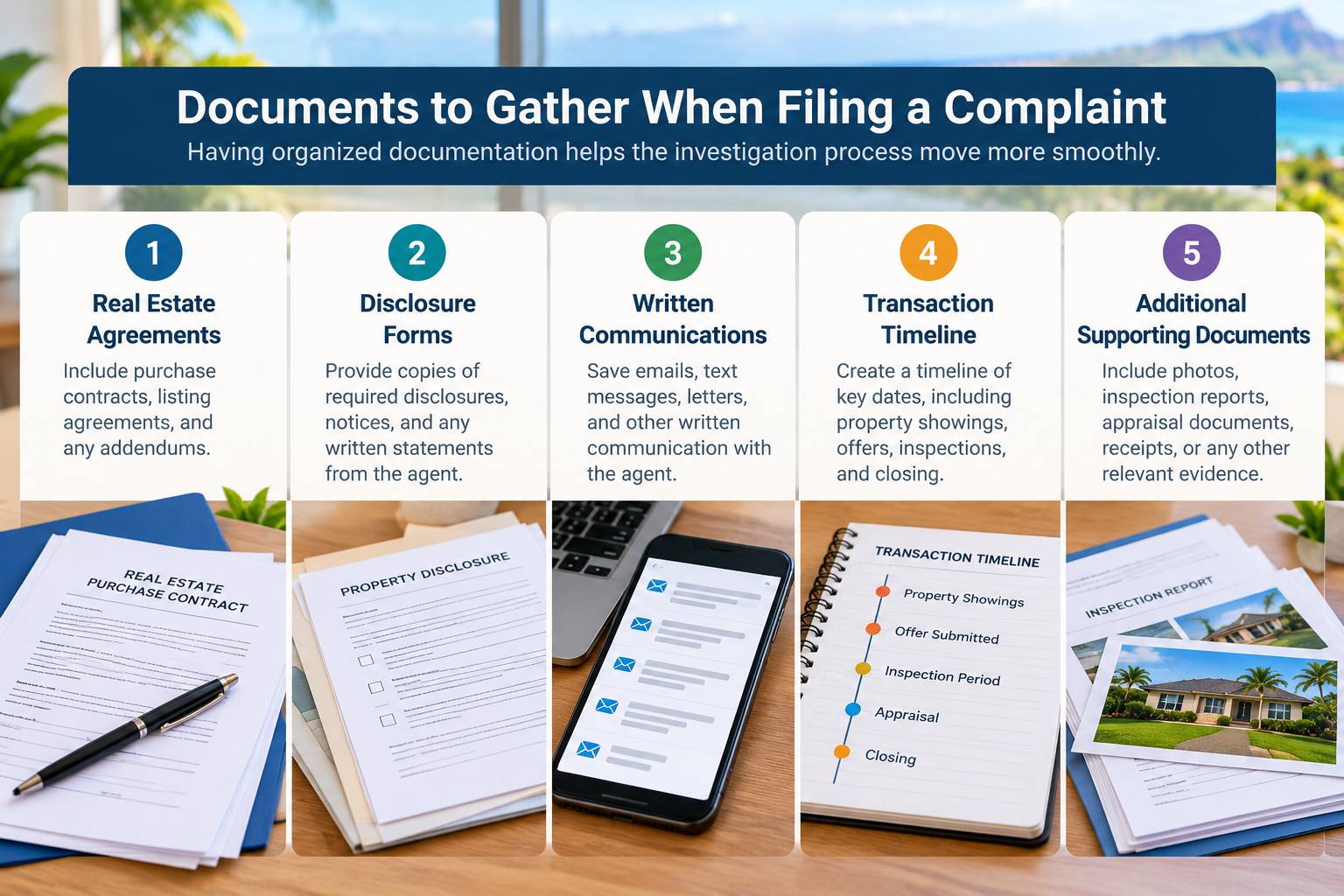
You can prepare by gathering:
Your signed listing or buyer representation agreement.
Purchase contracts and relevant amendments.
Seller disclosures and inspection reports.
Emails, text messages, and other communications.
Escrow statements and payment records.
A dated timeline describing what happened.
A clear explanation of the resolution you are requesting.
Keep your written complaint factual and specific.
For example, identify the disputed charge, the contract provision you believe applies, and the supporting statement showing the amount collected.
Avoid relying only on general descriptions such as poor service or unprofessional behavior.
When should you skip informal resolution?
You do not need to wait for an internal brokerage response before seeking regulatory or legal assistance.
If you suspect fraud, unlicensed activity, misuse of funds, or an approaching legal deadline, consider contacting the appropriate authority or attorney immediately.
A written request to the broker can be useful, but it should not delay time-sensitive action.
How to File a Complaint With Hawaiʻi RICO
The Regulated Industries Complaints Office, commonly called RICO, is part of Hawaiʻi's Department of Commerce and Consumer Affairs.
RICO reviews allegations involving licensed professionals and suspected unlicensed activity.
Steps for submitting a complaint
Step 1: Check the agent's license
Use the state's professional licensing and complaint resources to research the agent or brokerage.
Confirm the professional's identity and available licensing information.
Step 2: Prepare your complaint
Describe the alleged conduct, identify the people involved, and provide the relevant transaction details.
Include supporting documentation rather than submitting only a general accusation.
Step 3: Submit your complaint
You can begin through the official Hawaiʻi RICO complaint portal.
DCCA states that there is no fee to file a RICO complaint. It also advises consumers to report concerns promptly because older events may be harder to investigate.
Step 4: Understand the review process
RICO screens complaints to determine whether they fall within its jurisdiction. Appropriate matters may proceed to investigation and potential enforcement review.
Not every complaint results in disciplinary action.
What can RICO do?
Depending on the circumstances and applicable legal procedures, licensing enforcement may result in disciplinary measures.
However, RICO does not act as your personal attorney and does not represent consumers seeking private monetary damages.
If your primary goal is recovering financial losses, you may need a separate legal remedy.
How to File a REALTOR® Ethics Complaint
Not every licensed real estate agent is a REALTOR®.
The REALTOR® designation identifies membership in the National Association of REALTORS® and carries obligations under its Code of Ethics.
If the agent belongs to a REALTOR® association, you may be able to file an ethics complaint through the appropriate local association.
What happens during an ethics complaint?
The association reviews whether the alleged conduct may violate the Code of Ethics.
Depending on its procedures, the process may involve preliminary review, informal resolution opportunities, and a formal hearing.
Possible disciplinary outcomes include education, reprimands, fines, or membership sanctions.
REALTOR® associations cannot revoke a state real estate license or award damages to the person filing an ethics complaint.
Is there a deadline?
Under the National Association of REALTORS®' 2026 procedures, ethics complaints generally must be filed within 180 days after the alleged conduct and related facts could reasonably have been known, or within 180 days after the transaction or event concludes, whichever is later.
Certain informal dispute-resolution procedures can affect the filing period. Confirm the applicable rules directly with the association.
Do not assume that filing a state licensing complaint extends an association deadline.
For Hawaiʻi Island transactions, Hawaiʻi Island REALTORS® provides information about its professional standards procedures.
For other islands, contact the appropriate local REALTOR® association to confirm membership and filing instructions.
Can You Recover Money After an Agent's Misconduct?
Regulatory and ethics proceedings focus primarily on professional conduct.
Recovering money generally involves a different process.
Depending on the dispute, options may include negotiation, mediation, arbitration, or civil litigation.
Review your agreement for provisions that may govern dispute resolution.
Hawaiʻi's Real Estate Recovery Fund
Hawaiʻi maintains a Real Estate Recovery Fund under HRS §467-16.
The fund provides a potential recovery mechanism for certain qualifying losses involving fraud, misrepresentation, or deceit by licensed real estate professionals.
The statute provides for recovery of up to $25,000 per transaction, subject to its requirements. Recovery may involve a commission settlement or qualifying court order, so it is not accurate to assume that every claim requires first obtaining a judgment.
The fund is not a general reimbursement program for every disappointing real estate transaction.
Consult a Hawaiʻi real estate attorney about eligibility, procedural requirements, and applicable deadlines.
Filing with RICO should not be assumed to pause the time limit for a separate civil claim.
How to Protect Yourself Before Your Next Real Estate Transaction
Whether you're buying your first home or selling a long-held property, clear expectations can help reduce misunderstandings.
Before choosing representation, verify the agent's license and review the written agreement.
Pay attention to compensation, representation duties, agreement duration, and termination provisions.
Ask questions when terms are unclear.
For buyers, review property disclosures and arrange appropriate inspections. For sellers, understand your disclosure responsibilities and how offers will be presented.
Keep important decisions and changes in writing.
Why local guidance matters in Hawaiʻi
Hawaiʻi transactions can involve property-specific considerations such as leasehold ownership, condominium association requirements, land-use restrictions, and remote purchasing arrangements.
At Hawaiʻi Modern Realty, we combine local market knowledge with modern property-search resources and personalized guidance to help buyers and sellers understand these details.
Our digital tools, including AI-supported search capabilities where available, help people explore properties, while our real estate professionals provide the human guidance needed to evaluate important decisions.
We believe technology should make information easier to access, not replace clear communication between clients and their agents.
Our Service Areas and Property Expertise
As a locally owned, independent brokerage, we serve clients across Hawaiʻi.
Our residential real estate services include:
Oʻahu: Single-family homes, condominiums, and luxury real estate.
Maui: Residential properties and luxury homes.
Hawaiʻi Island: Homes, condominiums, and distinctive residential properties.
Kauaʻi: Residential and luxury real estate.
Condominiums: Guidance on ownership costs and association considerations.
Rental and investment properties: Buying and selling representation, with applicable restrictions reviewed separately.
Luxury homes: Representation for higher-value residential properties.
Open houses and property showings: Opportunities to evaluate available homes.
Military and family relocation: Support for clients moving to or within Hawaiʻi.
Our brokerage has helped more than 3,000 families and is a member of Leading Real Estate Companies of the World®, an international real estate network.
Frequently Asked Questions About Hawaiʻi Real Estate Agent Complaints
What is the most common complaint against real estate agents?
Common concerns include communication problems, misrepresentation, disclosure disputes, and disagreements about compensation or transaction handling. The frequency of specific complaints varies, and no verified Hawaiʻi-specific ranking is established here.
Can I file a complaint after closing?
Potentially, yes. The available process and applicable deadlines depend on the type of complaint. Contact the relevant authority promptly rather than assuming a closed transaction prevents further action.
Can I file a complaint against an agent who is not a REALTOR®?
Yes. Licensed agents who are not REALTOR® members remain subject to Hawaiʻi's real estate licensing laws. You may report suspected licensing violations through RICO.
Can RICO make my agent refund a commission?
RICO's licensing enforcement process is not a substitute for pursuing a private refund or damages claim. A commission dispute may require negotiation or legal proceedings.
How do I check whether a Hawaiʻi real estate agent has complaints?
Start with DCCA's licensing and RICO complaint-history resources. Remember that a complaint record does not necessarily mean misconduct was established.
Should I hire an attorney before filing a complaint?
An attorney is not required to submit a RICO complaint. However, legal advice may be particularly important when significant financial losses, contract disputes, or filing deadlines are involved.
Planning Your Next Hawaiʻi Real Estate Move?
Understanding your rights is an important part of making informed real estate decisions.
If you're dealing with a suspected licensing violation, use the appropriate regulatory or legal process. Hawaiʻi Modern Realty is not a substitute for RICO, a REALTOR® association, or independent legal counsel.
If you're preparing for a new purchase or sale, we're here to help you understand your representation options and approach the transaction with clear expectations.
Our team combines Hawaiʻi real estate knowledge, modern tools, and personalized service to support your next move.
Ready to work with a brokerage that values clear communication and informed decisions?
Contact Hawaiʻi Modern Realty to discuss your buying or selling goals.